Blog Post
The Warrior Operating System: 6 Parts of You, One System
August 3, 2026
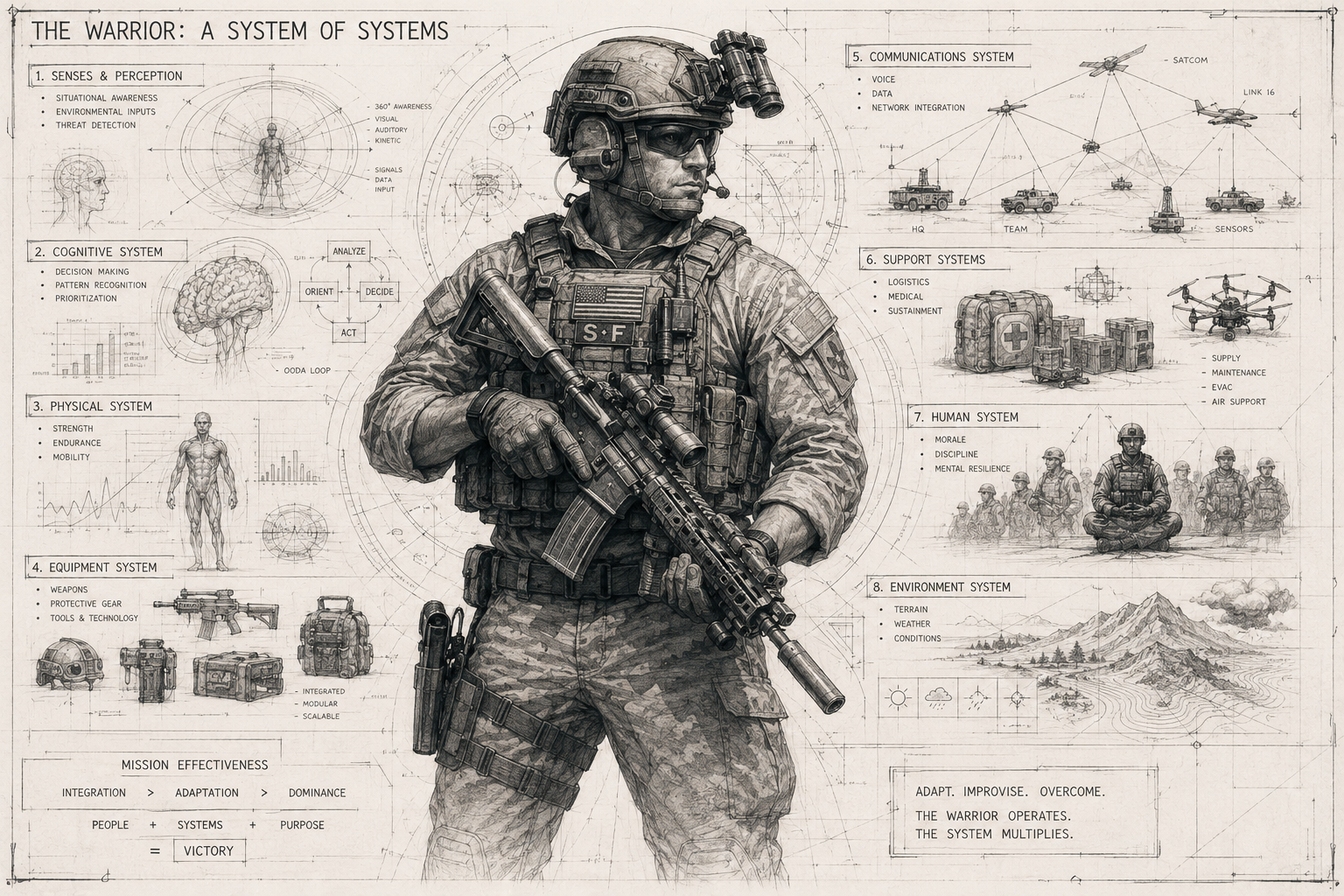
The system of systems
Think of yourself like a car. You’ve got an engine, a fuel system, brakes, a steering wheel, a GPS, and a driver behind the wheel. If any one of those breaks down, it doesn’t matter how good the rest are, the car doesn’t get you where you’re going.
The Warrior Operating System (WOS) treats a person the same way. Instead of looking at “stress” or “motivation” or “leadership” as separate problems, it sees them as six connected parts of one system. Fix one part in isolation and the others can still drag you down. Understand how they work together, and you can actually run yourself like a well-tuned machine.
WOS comes in two modes. 1.0 is repair mode, stopping the bleeding, calming the chaos, getting back to a stable baseline. 2.0 is performance mode, once you’re stable, this is about getting sharper, stronger, and more effective than before. You can’t skip to 2.0 without 1.0 holding steady first; you can’t optimize a system that’s still on fire.
Here are the six parts.
1. Your Mind Under Pressure
This is the part of you that decides what things mean and how you react to them, your focus, your judgment, your ability to keep your cool when someone’s pushing your buttons.
In repair mode, this is about breaking the cycle where your brain gets stuck in “threat mode” and overreacts to everything. In performance mode, it’s about making sharp, level-headed calls even when the pressure’s on.
What it takes: understanding how snap judgments differ from careful thinking, learning to reframe situations instead of spiraling, and building the muscle to pause before reacting.
Why it matters to everything else: when this part breaks down, tired and reactive thinking leads to conflicts, bad decisions, and mistakes everywhere else in your life.
2. Your Body’s Fuel Tank
This is your energy, your sleep, your nervous system, the physical fuel that everything else runs on. You can have great intentions and a sharp mind, but if your tank’s empty, none of it holds up.
Repair mode here means fixing sleep, calming an overloaded nervous system, and recovering from burnout. Performance mode is about training your energy and recovery like an athlete would — treating rest as part of the job, not a reward for finishing it.
What it takes: understanding how chronic stress wears down the body, learning to read your own body’s signals, and building real recovery habits, sleep, breathing, downtime that actually works.
Why it matters: this is the floor everything else stands on. Run it empty, and your mind, your motivation, and your relationships all start to crack.
3. Your Drive and Your Word
This is what keeps you showing up, your motivation, your self-discipline, and whether your actions actually match who you say you are.
In repair mode, this is about rebuilding a sense of “I can do this” after a period of shame or feeling powerless. In performance mode, it’s about turning motivation into a system you can rely on, instead of something that comes and goes with your mood.
What it takes: understanding what actually drives people (hint: it’s rarely just willpower), building simple “if this happens, I do that” plans, and tying your habits to the person you want to be, not just a goal on a list.
Why it matters: when your values and your actions drift apart, motivation collapses, and so does follow-through.
4. Your People
This is trust, relationships, and how you show up in a group, whether that’s your family, your team, or your community.
Repair mode here is about rebuilding trust and boundaries after betrayal or disconnection. Performance mode is about building real cohesion, teams and relationships that hold up under pressure instead of falling apart at the first conflict.
What it takes: understanding how trust and safety get built (or destroyed), practicing real conflict repair instead of avoidance, and treating group culture as something you actively build, not something that just happens.
Why it matters: when this breaks down, everything grinds to a halt, decisions stall, coordination fails, and people stop pulling in the same direction.
5. Getting Things Done
This is where everything else turns into action, your planning, your decision-making, your ability to follow through and lead.
Repair mode is about restoring basic reliability after things have fallen apart, showing up, following through, leading yourself again. Performance mode is about sharpening judgment and execution in high-stakes, complicated situations.
What it takes: learning how experienced decision-makers actually think under pressure, practicing “what could go wrong” before you commit to a plan, and reviewing what happened afterward so you actually improve instead of just repeating yourself.
Why it matters: this is the visible output of everything above it. Bad judgment here shows up as missed goals and broken plans, even if the cause is really fatigue, low motivation, or a fractured team underneath.
6. Who You Are and Why It Matters
This is the deepest layer, your sense of identity, your values, your moral compass, your sense of purpose. It’s what makes leadership legitimate and gives everything else a “why.”
Repair mode here is about healing from guilt, betrayal, or a shattered sense of self. Performance mode is about leading from a clear, values-driven place, the kind of integrity that earns trust rather than demands it.
What it takes: understanding how people build a coherent life story, clarifying what you actually value versus what you’ve just inherited, and making decisions that are consistent with who you say you are.
Why it matters: this is the anchor. When it cracks, motivation collapses, leadership loses legitimacy, and trust erodes, even if every other system looks fine on paper.
How It All Fits Together
Picture these six stacked on top of each other, not sitting side by side:
Your sense of identity and values (6) sets the direction and makes your motivation (3) durable. Your body (2) and your mind under pressure (1) supply the fuel and the judgment to act on that motivation. Your relationships (4) create the stable ground that good decisions depend on. And all of it shows up in the real world through planning and execution (5), the part everyone else actually sees.
The key insight is that none of these operate alone. Run low on sleep, and your judgment slips. Let judgment slip, and relationships take the hit. Let relationships fray, and execution falls apart. It’s rarely just one broken part, it’s usually a chain reaction. That’s why WOS treats a person like a system to be diagnosed and tuned, not a collection of separate problems to be solved one at a time.