Uncategorized
Category 2 — Energy, Recovery & Physiological Readiness
August 31, 2026
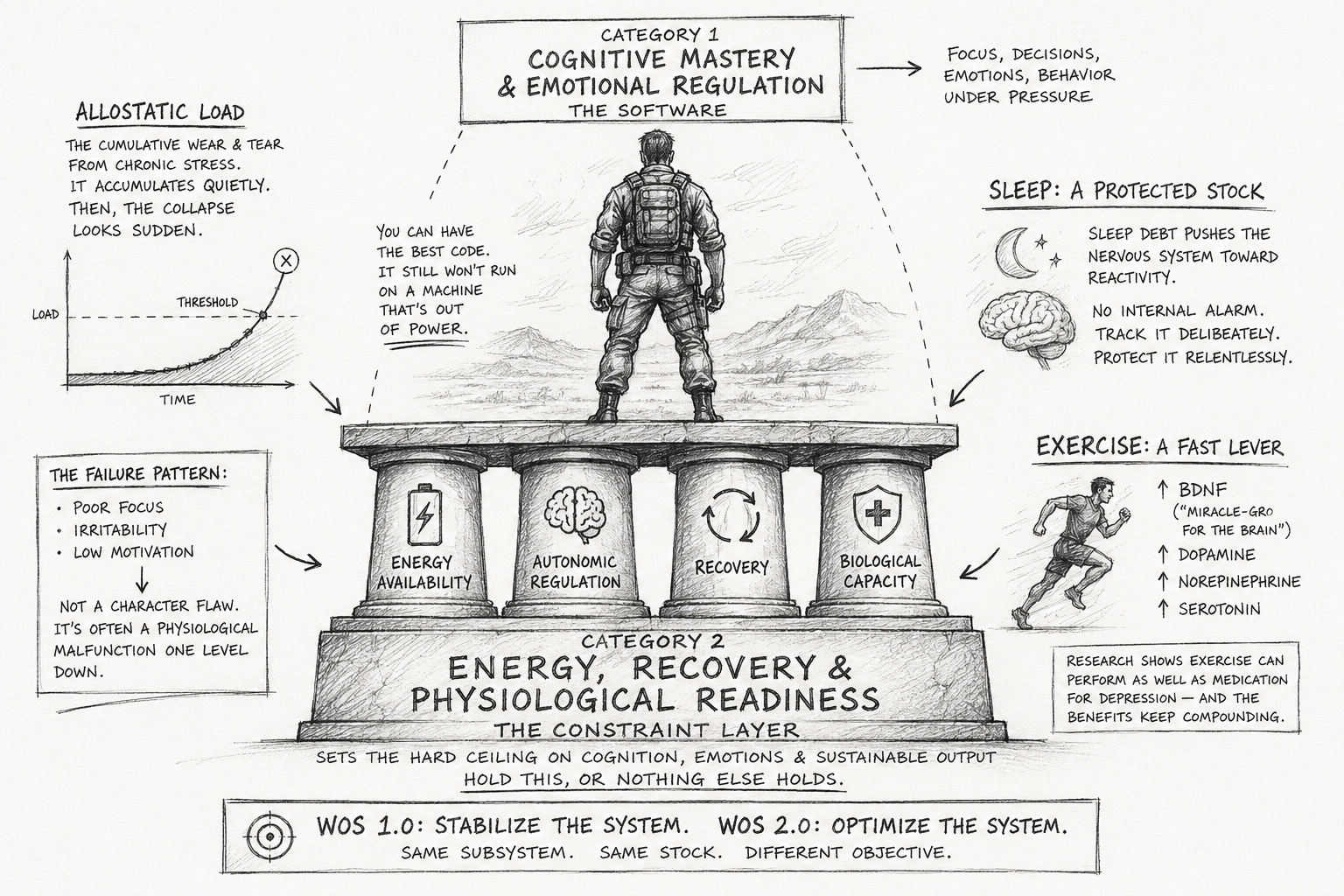
Last week we opened this series by breaking down Category 1, Cognitive Mastery and Emotional Regulation, the subsystem that governs how we think and feel under pressure. This week we will go one layer deeper, to the subsystem that everything else in the Warrior Operating System sits on top of. Category 2 is Energy, Recovery, and Physiological Readiness, and if Category 1 is the software, this is the hardware. You can have the best code in the world but it still won’t run on a machine that’s out of power.
The Constraint Layer Beneath Everything Else
In the WOS architecture, Category 2 governs energy availability, autonomic regulation, recovery, and biological capacity. We call it the constraint layer for a specific reason: it doesn’t just influence cognition, emotional stability, and sustainable output, it puts a hard ceiling on all three. You cannot think your way past a depleted nervous system. You cannot discipline your way past a body running on three hours of sleep a night for two weeks straight. The subsystem underneath has to hold, or nothing built on top of it holds either.
This is one of the most consistent failure patterns I’ve watched in veterans and first responders, and honestly in myself. Someone shows up struggling with focus, irritability, or motivation, and the instinct, theirs and often everyone around them, is to treat it as a character problem. Not disciplined enough. Not motivated enough. Nine times out of ten, the actual malfunction is one level down, in the physiological subsystem nobody thought to check.
Allostatic Load: The Stock Nobody Names
Neuroscientist Bruce McEwen gave us the term allostatic load, the cumulative wear and tear on the body and brain from chronic stress exposure. It’s a useful concept precisely because it behaves like a stock in the systems-engineering sense: it accumulates over time, it depletes capacity gradually, and by the time it’s visible from the outside, a lot of the damage is already done (latency). Someone under chronic operational tempo, whether that’s combat deployments or a relentless work schedule, can look functional for months while allostatic load quietly climbs. Then a threshold gets crossed, and the collapse looks sudden even though it wasn’t.
That delay is what makes physiological depletion so dangerous and so easy to dismiss. Matthew Walker’s research on sleep, laid out in Why We Sleep, makes the same point from a different angle. Chronic sleep restriction degrades memory consolidation, emotional regulation, immune function, and cardiovascular health, and it does it well before a person notices they’re impaired. Walker’s research is blunt about this: the human body did not evolve a reliable internal alarm for sleep debt the way it did for hunger or thirst. You have to track it deliberately, because it won’t announce itself until the cost has already been paid.
Sleep as a Protected Stock
That’s why we treat sleep the way an engineer treats a critical system input, not a nice-to-have but a protected stock that everything downstream depends on. Stephen Porges’ polyvagal theory gives us the mechanism for why this matters so directly. Our autonomic nervous system runs on a hierarchy of states, from calm and socially engaged down through fight-or-flight into shutdown, and sleep debt pushes the whole system toward the more reactive end of that hierarchy before a person consciously feels anything is wrong. A sleep-deprived nervous system is a nervous system primed for threat detection, and that shows up as irritability, hypervigilance, and impaired judgment long before it shows up as someone falling asleep at their desk.
From a healing perspective we treat this as a stabilization problem: reduce allostatic overload, restore sleep and autonomic balance, and rebuild baseline regulation capacity after trauma or burnout. A high-performance perspective treats the same subsystem as an optimization problem: energy efficiency, recovery discipline, and stress resilience under sustained high performance. Same subsystem, same stock, two different objectives depending on where someone is starting from.
Exercise as the Fastest Lever We Have
If sleep is the protected stock, exercise is one of the fastest leverage points we have for replenishing it and for repairing the systems that sleep debt damages. John Ratey’s book Spark makes the case better than almost anything else I’ve read. Ratey, a Harvard psychiatrist, lays out the neuroscience of exercise in language that holds up: physical activity drives up brain-derived neurotrophic factor, BDNF, a protein he calls “Miracle-Gro for the brain” because of the role it plays in growing new neurons and strengthening the connections between existing ones. Exercise also elevates dopamine, norepinephrine, and serotonin, the same neurotransmitter systems targeted by most psychiatric medication, except here the delivery mechanism is a run instead of a prescription.
That’s not a metaphor Ratey reaches for casually. The research backing it is substantial. Babyak and colleagues ran a landmark study on exercise and major depression and found that a structured aerobic exercise program performed as well as antidepressant medication at reducing depressive symptoms, and at ten-month follow-up, the exercise group had a lower relapse rate than the medication group. Craft and Perna’s review of the literature on exercise and clinical depression reaches a similar conclusion: physical activity functions as a legitimate intervention in its own right, not merely an adjunct to other treatment, with effect sizes that hold up against more conventional approaches.
The cognitive research is just as strong. Hillman, Erickson, and Kramer’s review in Nature Reviews Neuroscience lays out how exercise improves attention, working memory, and executive function, the exact capacities Category 1 depends on. Erickson’s later work went further, showing that a year of moderate aerobic exercise actually increased hippocampal volume in older adults and reversed age-related memory decline by roughly one to two years..
None of this is new information to anyone who’s felt clearer after a hard workout. What the research gives us is the mechanism, and the mechanism is what lets us treat exercise as a prescription instead of a suggestion. In systems terms, physical activity is a leverage point that touches multiple subsystems at once: it replenishes energy, it regulates the autonomic nervous system, it improves the neurotransmitter balance underneath mood and motivation, and it strengthens the exact cognitive capacity Category 1 needs to function under stress.
Small Choices, Compounding Returns
Tom Rath’s Eat Move Sleep is a useful complement here because it strips the science down to something a person can actually act on day to day. Rath’s core argument is that food, movement, and sleep are not three separate wellness categories, they’re one interlocking system, and small daily choices in each domain compound over time into large differences in energy, mood, and health outcomes. That framing matches exactly how we think about Category 2. Nobody fixes allostatic load with a single dramatic intervention. You fix it the way you’d fix any depleted stock: with consistent, deliberate inflows that outpace the outflows, day after day, until the trend line moves.
What This Looks Like at Warriors’ Ascent
Our own outcomes data backs this up in practice, not just in theory. The peer-reviewed pilot study on our program, published in the Journal of Psychotherapy Integration, built roughly three hours of mindfulness-based practice into each day of the five-day cohort, including breathwork and movement designed to shift participants out of a sympathetic, threat-primed state and into one where the cognitive and emotional work could actually take hold. That sequencing isn’t incidental. You cannot do effective cognitive reappraisal or emotional processing work with a nervous system still running hot. Physiology has to come first, or the rest of the architecture has nothing stable to stand on.
Some of the specific tools are worth naming, because they’re chosen deliberately, not incidentally. Yoga is one of the most low-barrier mind-body interventions available to us. Nobody has to be flexible or athletic to lie on a mat and move through a slow sequence paired with breath, and that low barrier matters when the person in front of you is already carrying an overloaded nervous system. Nutrition gets the same deliberate treatment. Cohorts eat whole, health-supportive food and snacks, and chips, candy, cake, ice cream, and alcohol stay off the table. That’s not about restriction for its own sake. It’s because we’re not going to spend four days regulating a nervous system with breathwork and mindfulness while a blood sugar rollercoaster works against us in the background. We also bring in a certified strength and conditioning coach to run a block on basic exercise physiology, so participants leave understanding the mechanism behind what they just experienced, not just the experience itself. And because sleep is the protected stock everything else depends on, we teach sleep hygiene directly and use yoga nidra, a guided deep-relaxation practice, as a specific tool for improving sleep quality, energy, focus, and overall wellbeing.
That’s the practical translation of “constraint layer.” We don’t ask a veteran to out-think a dysregulated nervous system. We regulate the physiology first, deliberately, using tools with real evidence behind them, and everything else in the program gets easier because the hardware is finally running the way it’s supposed to.
Why This Matters Beyond the Program
This is also where the WOS framework could be very relevant to a corporate or executive audience, because readiness, in the way we define it, isn’t a wellness perk. It’s a performance capacity, trainable the same way strength or expertise is trainable. Recovery isn’t time off from output, it’s the mechanism that makes sustained output possible. An organization that treats sleep, movement, and recovery as optional for its highest performers is running the same failure mode we see in individuals: burning down a stock faster than it can be replenished, and calling the eventual collapse a surprise.
What’s Ahead
Next in this series is Category 3, Motivation and Discipline, and the honest case for why discipline outlasts motivation every time they’re put in competition with each other. But none of that works without the ground we covered today. Discipline runs on the same depleted nervous system as everything else. Fix the hardware first.
References
McEwen, B. S. (1998). Protective and damaging effects of stress mediators. New England Journal of Medicine, 338(3), 171-179.
Walker, M. (2017). Why We Sleep: Unlocking the Power of Sleep and Dreams. Scribner.
Porges, S. W. (2011). The Polyvagal Theory: Neurophysiological Foundations of Emotions, Attachment, Communication, and Self-Regulation. W. W. Norton.
Ratey, J. J., & Hagerman, E. (2008). Spark: The Revolutionary New Science of Exercise and the Brain. Little, Brown and Company.
Rath, T. (2013). Eat Move Sleep: How Small Choices Lead to Big Changes. Missionday.
Babyak, M., Blumenthal, J. A., Herman, S., Khatri, P., Doraiswamy, M., Moore, K., Craighead, W. E., Baldewicz, T. T., & Krishnan, K. R. (2000). Exercise treatment for major depression: Maintenance of therapeutic benefit at 10 months. Psychosomatic Medicine, 62(5), 633-638.
Craft, L. L., & Perna, F. M. (2004). The benefits of exercise for the clinically depressed. Primary Care Companion to the Journal of Clinical Psychiatry, 6(3), 104-111.
Hillman, C. H., Erickson, K. I., & Kramer, A. F. (2008). Be smart, exercise your heart: Exercise effects on brain and cognition. Nature Reviews Neuroscience, 9(1), 58-65.
Erickson, K. I., Voss, M. W., Prakash, R. S., et al. (2011). Exercise training increases size of hippocampus and improves memory. Proceedings of the National Academy of Sciences, 108(7), 3017-3022.
Liese, B. S., & Monley, C. M. (2023). Feasibility of multimodal group treatment for veterans with PTSD, depression, and high-risk drinking: A pilot study. Journal of Psychotherapy Integration. Advance online publication.