Blog Post
Category 3 — Motivation & Discipline: Why Discipline Outlasts Motivation
September 8, 2026
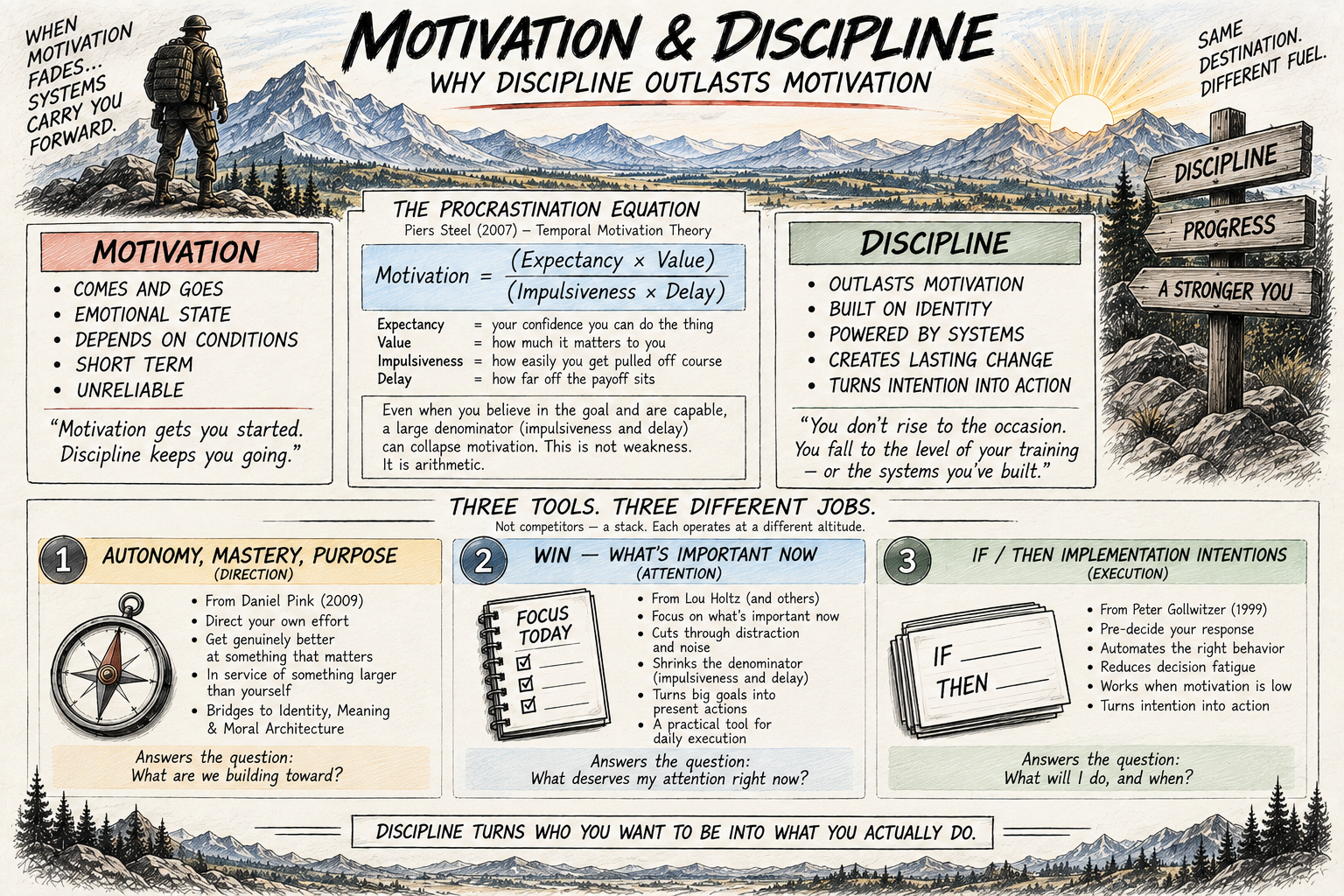
Motivation is not necessarily a character trait. It’s a mental state, a stock that rises and falls with conditions, not a switch you either have on or don’t. Motivation researcher Piers Steel has actually built an equation that breaks motivation down into its component parts, one that gives us a real sense of when and where it’s likely to fail us, and for what reasons. Discipline outlasts motivation because discipline does not depend on that equation working in your favor. It runs on identity and structure instead. That is the third pillar of the Warrior Operating System, and it is one of the most practical categories in the whole framework.
Where This Comes From
I’ve witnessed this firsthand, in myself and in officers I served alongside, in Special Forces, and later as an instructor at CGSC and SAMS. When motivation wears off, and it always does, discipline is what carries the day, or it doesn’t. You don’t rise to the occasion. You fall to the level of your training, or the level of the systems you’ve built to catch you once the will runs out. The same pattern shows up in recovery. A veteran leaves our program on fire, certain this time is different, but if he doesn’t execute with discipline, with a plan and systems in place to make the change last, nothing will change. That gap between intention and follow-through is not a discipline problem in the moral sense. It is a design problem, and design problems have design solutions.
Category 3 of the Warrior Operating System draws on Self-Determination Theory (Ryan & Deci, 2000), Peter Gollwitzer’s implementation-intention research, and Angela Duckworth’s work on grit and perseverance. WOS 1.0 uses these tools to restore agency and self-efficacy after shame or helplessness has taken them away. WOS 2.0 uses the same tools to build durable, self-directed discipline once stability is back. Same category, same mechanics, two different starting points.
The Procrastination Equation
Start with the honest version of the problem. Piers Steel, a motivation researcher at the University of Calgary, built this equation with Cornelius König as a general theory of motivation, Temporal Motivation Theory, pulling together decades of research on expectancy, hyperbolic discounting, and need theory into a single formula (Steel & König, 2006). A year later, Steel applied that same equation specifically to procrastination, in a meta-analysis he called quintessential self-regulatory failure (Steel, 2007), which is why most people know it today as the procrastination equation. Same math either way. Here it is:
Motivation = (Expectancy × Value) / (Impulsiveness × Delay)
Expectancy is your confidence you can actually do the thing. Value is how much it matters to you. Impulsiveness is how easily you get pulled off course by something more immediately rewarding. Delay is how far off the payoff sits.
Look at what that equation predicts. A veteran can believe deeply in his recovery (high value), be entirely capable of the work (high expectancy), and still lose the fight most days, because the payoff for staying regulated is weeks or months away while the relief of a drink, an argument, or isolating in a dark room is immediate. Large denominator, motivation collapses, regardless of how much he wants it. This is not weakness. It is arithmetic. Most programs try to raise the numerator by rekindling inspiration. We spend more of our effort shrinking the denominator, because that is the half of the equation you can actually engineer.
Three Tools, Three Different Jobs
Once you accept that motivation is unreliable by design, the real question changes. It stops being “how do I get motivated” and becomes “what system keeps producing the right action when motivation doesn’t show up.” We teach three constructs for that, and the mistake most people make is treating them as competitors instead of a stack. Each one operates at a different altitude.
Autonomy, Mastery, Purpose (direction). Daniel Pink’s research on intrinsic drive, what he calls Motivation 3.0 in his book Drive (Pink, 2009), argues that once the basics are covered, carrots and sticks stop producing durable motivation, and three things take over instead: autonomy, directing your own effort; mastery, the pull of getting genuinely better at something that matters; and purpose, knowing the effort is in service of something larger than yourself. This isn’t an intervention either. It’s a way of evaluating whether the structure you’re building someone into actually generates its own fuel, or whether it’s still running on external pressure. That question sits at the top of the stack because it answers something the other two tools cannot: once someone is no longer just surviving, what are we actually helping them build? That is the exact conceptual territory of the shift from WOS 1.0 to WOS 2.0, and it’s why autonomy, mastery, and purpose live alongside Category 6, Identity, Meaning & Moral Architecture, in our framework.
WIN (attention). “What’s Important Now” is commonly associated with football coach Lou Holtz, though the underlying idea, focus attention on the immediate priority, predates the acronym by roughly two thousand years. It’s an operational restatement of the Stoic dichotomy of control. Epictetus opened the Enchiridion by dividing everything in life into what’s up to us and what isn’t, and argued that suffering comes from spending energy on the second category instead of the first. Control the controllable. WIN is that same discipline compressed into one question you can actually ask under pressure. It is not a psychological theory. It is a cognitive tool, and its value is narrow and specific: when someone is overwhelmed, distracted, or emotionally activated, it collapses an unmanageable situation down to the one piece they can actually act on right now. Not “fix everything.” Just: what’s important now, and what can I control about it?
WOOP (execution). Gabriele Oettingen, a psychologist at NYU, spent decades studying why positive thinking alone fails to produce behavior change. What she found cuts against most goal-setting advice: people who only picture a great outcome, with no thought to what’s standing in the way, actually lose energy and effort toward the goal, not gain it (Kappes & Oettingen, 2011). Pure positive fantasy feels like progress. It isn’t. What actually works is mental contrasting, picturing the best outcome in vivid detail and then immediately confronting the specific internal obstacle standing between you and it (Oettingen, Pak, & Schnetter, 2001). That collision, wish against obstacle, is the mechanism, and it’s the single most important part of the tool. It’s what turns a goal from merely appealing into one the mind treats as binding, and it does that filtering automatically: when someone genuinely has what it takes to clear the obstacle, mental contrasting increases their effort toward it; when they don’t, it correctly lets the goal go instead of burning energy chasing it. WOOP, Wish, Outcome, Obstacle, Plan, is Oettingen’s packaging of that mechanism into four steps a person can run in under two minutes (Oettingen, 2014). The wish and outcome set up the contrast. The obstacle is where the actual work happens. The plan, which is really an if/then implementation intention, only comes after the contrast has done its job. WOOP has moved well past self-help. A 2024 randomized controlled trial published in Contemporary Clinical Trials is currently testing it as an enhancement to the VA’s MOVE! weight-management program for veterans (Vandyousefi et al., 2024), which tells you this construct is being taken seriously in exactly the population we serve.
Stacked, the three read as a chain: autonomy, mastery, and purpose set the direction (what actually generates durable drive), WIN directs attention (given everything happening, what matters most right now), and WOOP converts intention into a plan (what do I want, what will interfere, and what will I do about it). Direction, then attention, then execution.
The Piece That Does the Most Work
Here is where it gets genuinely practical. Buried inside WOOP’s final step, the Plan, is a construct that is arguably more important on its own than the tool that contains it: the if/then implementation intention, developed by psychologist Peter Gollwitzer.
A goal intention says, “I intend to exercise tomorrow.” An implementation intention says, “If it’s 0600 on a training day, then I put on my shoes and go.” The second version pre-decides the response before the moment arrives, which matters because the moment you most need good judgment is usually the moment you are least capable of producing it under stress, fatigue, or emotional load. A meta-analysis of implementation-intention research covering dozens of studies found a medium-to-large effect on goal attainment, d = 0.65 (Gollwitzer & Sheeran, 2006), which is a large effect size for a behavioral intervention this simple.
We do not limit if/then planning to fitness goals. In Category 3, it becomes a general self-regulation protocol that participants can carry into any domain:
| Domain | If… | Then… |
|---|---|---|
| Stress | I notice my physiological activation rising | I slow my breathing and lengthen the exhale |
| Anger | I feel the urge to react immediately | I pause and ask one question before responding |
| Rumination | I catch myself replaying the event | I name what’s controllable and take one action on it |
| Training | It’s 0600 on a training day | I put on my shoes and start |
| Alcohol | I’m offered a drink at an event | I order sparkling water |
| Leadership | I receive information that contradicts my plan | I ask, “What would have to be true for this to be correct?” |
| Overload | I feel pulled in five directions | I ask WIN: what’s important now |
Notice the last row. That is the stack working as one system, not three separate techniques.
The Loop: Notice, WIN, If/Then, Act, Assess
Put the whole thing together and you get a five-step sequence we teach as a single loop:
- Notice what’s happening internally and externally.
- WIN: what’s important now.
- If/Then: what is my pre-planned response to this condition.
- Act: execute instead of deliberating.
- Assess: did it work? Update the response.
That loop plugs directly into the Feedback and Adaptation cycle that runs through the entire Warrior Operating System. It works the same way whether you’re interrupting a maladaptive response during early recovery or automating a high-performance behavior once you’re stable, which is exactly why Category 3 sits where it does in the architecture: anchored above by Category 6 (identity and meaning, which is what makes the “why” durable), driving Category 5 (planning, decision, and execution), and moderated by Category 2 (energy and physiological readiness, because none of this holds up on no sleep).
Discipline Is an Identity Problem First
Here is the part that actually answers the question in the headline. Willpower is a depleting resource. You wake up with a finite amount of it and it burns down over the course of a hard day, which is exactly why relying on it to carry a recovery, a training plan, or a leadership standard is a losing strategy over any real timeline.
Identity does not deplete the same way. Self-Determination Theory (Ryan & Deci, 2000) found that behavior sticks when it satisfies three needs: autonomy, competence, and relatedness, the sense that this is my choice, I’m capable of it, and I’m not doing it alone. When a habit is wired to “this is who I am” instead of “I really should do this,” you stop needing daily motivation to perform it, the same way you don’t need to talk yourself into brushing your teeth.
Angela Duckworth’s research on grit makes the same case with a data set that happens to come from my own alma mater. In her original 2007 study, Duckworth tracked an entering class of West Point cadets through Beast Barracks, the seven-week summer training that has historically pushed out a meaningful share of each class before the academic year even begins (Duckworth, Peterson, Matthews, & Kelly, 2007). Her twelve-item Grit Scale, a measure of passion and perseverance for long-term goals, predicted who made it through Beast Barracks better than the Whole Candidate Score, West Point’s own admissions composite of SAT scores, class rank, physical fitness, and leadership rating. Talent and aptitude got those cadets in the door. Grit is what got them through it. Duckworth’s later work extended the finding: perseverance over the long run correlates less with intensity of desire and more with a stable, identity-level commitment to a small set of goals (Duckworth, 2016). That is the entire argument for identity-based discipline in one data point.
This is the whole point of building an operating system instead of running on inspiration. We are not trying to keep someone motivated for the rest of their life. We are handing them a structure, autonomy, mastery, and purpose to set the direction, WIN to manage attention, WOOP and if/then to convert intention into automatic action, that keeps producing the right behavior on the days the motivation does not show up. That is what capacity looks like instead of dependency. It is not a program you need forever. It is a system you can run yourself.
Next week: Category 4, Planning & Decision-Making Under Pressure, and why decision quality is a trainable skill rather than a fixed trait.
References
Duckworth, A. L. (2016). Grit: The power of passion and perseverance. Scribner.
Duckworth, A. L., Peterson, C., Matthews, M. D., & Kelly, D. R. (2007). Grit: Perseverance and passion for long-term goals. Journal of Personality and Social Psychology, 92(6), 1087-1101.
Epictetus. (2004). Enchiridion (G. Long, Trans.). Dover Publications. (Original work published c. 135 CE)
Gollwitzer, P. M., & Sheeran, P. (2006). Implementation intentions and goal achievement: A meta-analysis of effects and processes. Advances in Experimental Social Psychology, 38, 69-119.
Kappes, H. B., & Oettingen, G. (2011). Positive fantasies about idealized futures sap energy. Journal of Experimental Social Psychology, 47(4), 719-729.
Oettingen, G. (2014). Rethinking positive thinking: Inside the new science of motivation. Current.
Oettingen, G., Pak, H.-J., & Schnetter, K. (2001). Self-regulation of goal-setting: Turning free fantasies about the future into binding goals. Journal of Personality and Social Psychology, 80(5), 736-753.
Pink, D. H. (2009). Drive: The surprising truth about what motivates us. Riverhead Books.
Ryan, R. M., & Deci, E. L. (2000). Self-determination theory and the facilitation of intrinsic motivation, social development, and well-being. American Psychologist, 55(1), 68-78.
Steel, P. (2007). The nature of procrastination: A meta-analytic and theoretical review of quintessential self-regulatory failure. Psychological Bulletin, 133(1), 65-94.
Steel, P., & König, C. J. (2006). Integrating theories of motivation. Academy of Management Review, 31(4), 889-913.
Vandyousefi, S., Oettingen, G., Wittleder, S., Moin, T., Sweat, V., et al. (2024). Protocol for a prospective, randomized, controlled trial of Mental Contrasting with Implementation Intentions (MCII) to enhance the effectiveness of VA’s MOVE! weight management program: WOOP (Wish, Outcome, Obstacle, Plan) VA. Contemporary Clinical Trials, 141, 107523.