Blog Post
Category 4: Planning & Decision-Making Under Pressure
September 15, 2026
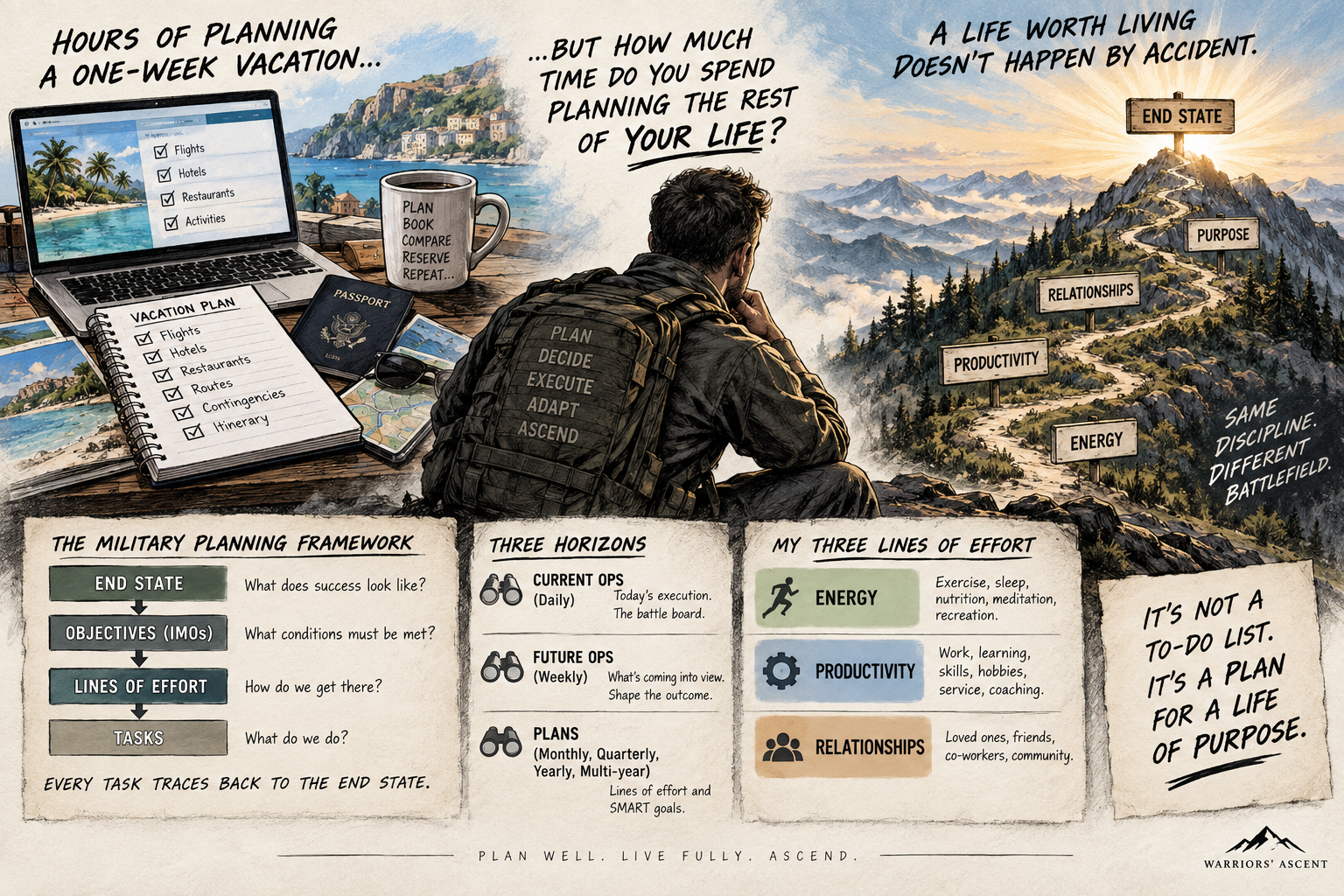
People spend more hours planning a one-week vacation than they spend planning the rest of their lives. That’s not a joke, it’s a measurable failure of prioritization, and it’s fixable, because decision quality is not a personality trait. It’s a trainable skill.
The Vacation Problem
Think about the last trip you planned. Flights compared across three sites. A spreadsheet, maybe. Restaurants researched, routes mapped, contingencies built in for weather and layovers. Hours of deliberate effort for seven days away from your life.
Now ask yourself how many hours you’ve spent planning the other fifty-one weeks of the year. For most people, the honest answer is zero. Life runs on autopilot, reaction, and whatever’s loudest that day.
That gap isn’t a discipline problem. It’s a doctrine problem. Nobody taught you how to plan a life the way the Army taught me how to plan an operation, so you default to the only planning method most people ever learn: the to-do list. A to-do list, on its own, isn’t a plan. It’s an inventory of tasks with no relationship to an outcome. You can clear a to-do list every day for a year and end the year exactly where you started.
What the Military Actually Taught Me
In the military, we didn’t start with tasks. We started with the end state, a clear, specific description of what “success” looks like when the operation is over. Between the end state and the day-to-day tasks sit objectives, often broken into intermediate military objectives (IMOs), the specific conditions that have to be met, in sequence, before the end state is reached. Only after those were defined did we work backward through lines of effort. Doctrinally, a line of effort is a campaign planning construct: it categorizes a set of projects, events, battles, operations, actions, and activities according to a unified purpose, linking them by cause and effect so everything is pulling toward the same conditions. Everything below a line of effort is a task in service of it, and nothing gets executed until someone can trace it back to the end state.
This is the backbone of the Military Decision-Making Process (MDMP) and the broader discipline of operational design, the doctrine for structuring ambiguous, complex problems before you ever touch a task list. Operational design forces you to answer the uncomfortable questions first. What is the actual problem, as opposed to the symptom in front of me? What does the environment look like? What’s the theory of the case for how I get from here to there?
A major piece of MDMP is what used to be called commander’s intent, now built into what doctrine calls mission command. It lays out the purpose, the key tasks, and the end state for every mission, the why behind the what. The value shows up the moment circumstances change and the tactical task you were given no longer fits the situation in front of you. If you understand the intent, you can adapt the task and still accomplish the purpose. If all you were ever given was a task, you’re stuck, either following an order that no longer makes sense or waiting on new instructions that may not arrive in time.
Most people never ask those questions about their own lives. They ask “what’s next on my list” instead of “what end state am I actually building toward, and does this line of effort even serve it.”
In my own life campaign plan, I run three lines of effort: Energy, Productivity, and Relationships. Three lanes, broad enough to hold years of effort, specific enough that I can tell inside a week whether I’m actually gaining ground or just staying busy.
- Energy covers the practices, habits, rituals, and activities that create and foster energy: exercise, meditation, sleep, nutrition, recreation.
- Productivity covers work-related tasks and projects, learning, skills development, hobbies, volunteering, coaching.
- Relationships covers investing in and cultivating the people in your life: loved ones, friends, co-workers.
Each of these is a focused, planned activity, not something squeezed into the white space between everything else when it happens to be available. If it isn’t scheduled as its own priority, it doesn’t get the ground it needs. Every goal I set gets tested against one question: which line of effort does this serve? If I can’t answer that, it doesn’t make the plan.
Three Horizons, Not One
I use three planning horizons, borrowed from the military, to plan the activities critical to achieving my goals.
- Current Ops, Daily. What’s actually happening today: the dashboard, the battle board, the calendar.
- Future Ops, Weekly. Doctrinally this window runs about 96 hours, but for our purposes we’ll focus on the work week: what’s coming into view over the next several days, the window where you can still shape the outcome before it becomes today’s emergency.
- Plans, Monthly, Quarterly, Yearly, Multi-year. The lines of effort themselves, and the SMART goals nested under them.
Most people only ever operate at the first altitude, reacting to today. A life campaign plan means you’re managing three timelines at once, so today’s task list is downstream of a weekly rhythm, which is downstream of a yearly plan, instead of being invented fresh every morning.
SMART Goals Are Not a To-Do List
A SMART goal, Specific, Measurable, Achievable, Relevant, Time-bound, looks simple on the surface, but the discipline underneath it is the same discipline behind a line of effort. A to-do list item says “work out.” A SMART goal says “increase deadlift 1RM by 20 lbs by March 1st, measured monthly.” One is a task floating in space. The other has a destination, a deadline, and a way to know if you’re actually winning.
The distinction matters because to-do lists reward activity. SMART goals, nested under real lines of effort, reward progress. Busy is not the same as effective, and I’ve watched plenty of high-performing people confuse the two.
Owning the Terrain You Control
For our purposes, time is the terrain on which you wage your battles and conduct your operations. You must seize key terrain, the ground that affords you a decided advantage. In a life campaign, that key terrain is the critical portions of your calendar, the windows that give you the opportunity to accomplish your mission, make progress, or achieve your goals. It doesn’t have to be every minute of your day, just enough to reach the decisive point, your objectives for the day accomplished. The highest-value ground you own is the two windows on either side of the day, the AM and PM bookends. Most of the middle of your day belongs to other people: meetings, kids, the job, the mission. The first hour after you wake up and the last hour before you sleep are disproportionately yours.
Time blocking is how you defend that terrain, and a DTG (date-time group, the military’s habit of stamping every order with an exact time) is how you make a block real instead of aspirational. “Work out sometime” never happens. “0530, 30-minute walk” does. If you don’t block it, someone or something else will take it: a phone, a notification, the gravitational pull of doing nothing on purpose. The people I’ve watched make the fastest gains, in the program and outside it, are the ones who treat their AM and PM bookends as protected ground, not open territory.
The Battle Board / Masterpiece Day
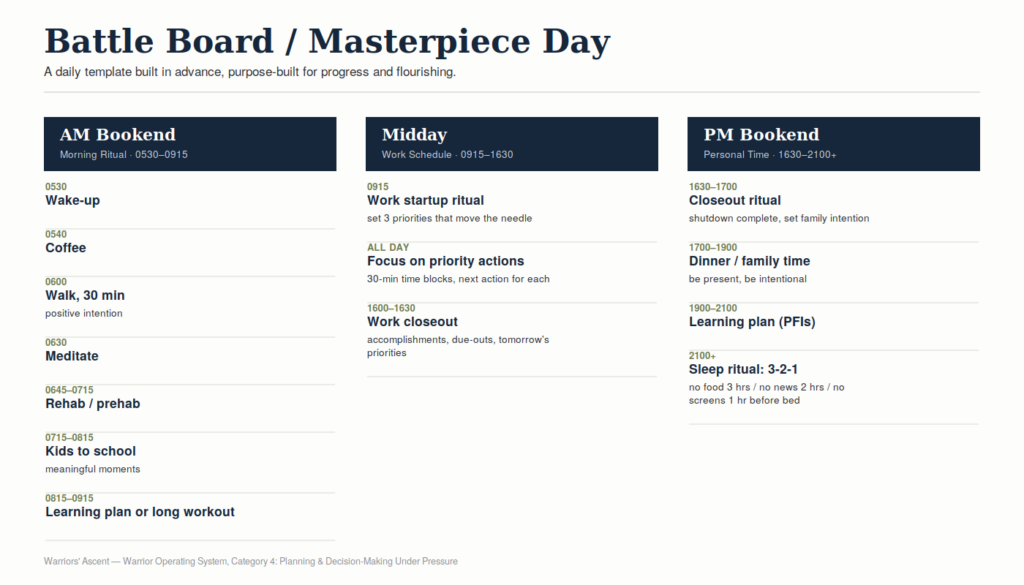
A Battle Board or Masterpiece Day is a tool we use to template an ideal day, purpose-built for progress and flourishing. It describes what an ideal day looks like, built in advance and irrespective of whatever the day throws at you. It focuses entirely on current operations, the next 24 hours, and it’s built entirely from ritual, not willpower.
- A startup ritual that opens the AM bookend the same way every time: wake, move, a deliberate window before the inbox ever opens, so the first hour of the day is spent, not lost.
- A work startup ritual that turns “here’s everything on my plate” into three priorities that will actually move the needle, paired with a work closeout ritual that reviews what got done, what’s still waiting, and what tomorrow’s priorities are, so the workday has a hard edge instead of bleeding into the evening.
- A shutdown ritual and digital sunset that close the PM bookend on purpose: a known point where the phone goes down and the day is declared complete, whether or not the list is empty.
- A sleep ritual, built on a simple 3-2-1 rule: no eating three hours before bed, no news or social media two hours before, no screens one hour before. Recovery becomes a scheduled event instead of something you get to if there’s time left.
An example Battle Board, the daily template used to pre-plan an ideal day across the AM bookend, the workday, and the PM bookend.
None of these rituals are complicated. Their power is that they’re the same every day, so they don’t require a decision, and a decision you don’t have to make under fatigue is a decision you can’t get wrong.
Where This Leaves You
You already know how to plan well. You’ve proven it every time you’ve planned a vacation. The problem isn’t capability. Nobody ever handed you the doctrine for applying that same rigor to the thing that actually matters: your life, your recovery, your leadership.
That doctrine exists. It’s been refined over decades in the most demanding planning environments in the world, and it doesn’t require a uniform to use. Define the end state. Build your lines of effort. Turn tasks into SMART goals that serve those lines. Guard your AM and PM bookends like terrain. Train your decision-making the way you’d train anything else you wanted to get better at.
This is Category 4 of the Warrior Operating System, Planning & Decision-Making Under Pressure. Next week, we turn to Category 5: what the science of belonging and tribe tells us about why none of this holds up if you’re trying to do it alone.