Blog Post
Category 5, Belonging, Tribe & Interpersonal Dynamics: Why Isolation Is a Loop and Belonging Is the Leverage Point
September 23, 2026
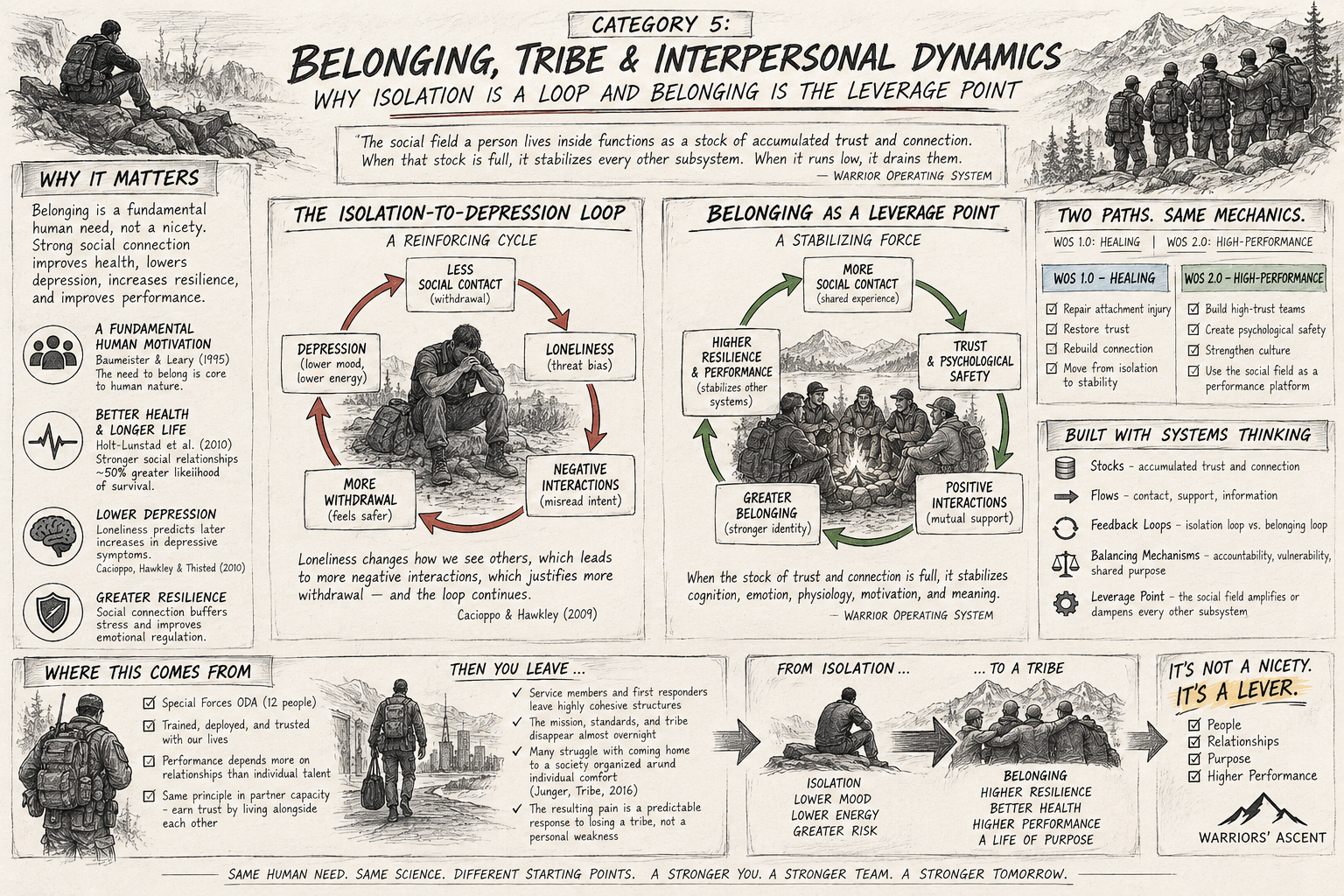
Belonging is one of the most powerful regulators of human recovery and performance, and one of the most underestimated. In the Warrior Operating System, the social field a person lives inside functions as a stock of accumulated trust and connection. When that stock is full, it stabilizes every other subsystem in the framework. When it runs low, it drains them, usually through a reinforcing loop in which isolation feeds depression and depression feeds further isolation, often with a delay long enough that nobody sees the collapse coming. Category 5, Belonging, Tribe & Interpersonal Dynamics, is where we interrupt that loop, and it is the reason the Warriors’ Ascent program is built around a cohort rather than a counselor’s office.
Where This Comes From
A Special Forces Operational Detachment Alpha is twelve people, and I spent two years commanding one. For that part of my career, the unit of action was a small team that trained together, deployed together, argued with each other, and trusted each other with their lives. Much of our work building partner capacity came down to the same thing: earning the trust of people from a very different culture by living alongside them long enough that they believed we had their backs. Over time I came to understand that a team’s performance under pressure depends less on the talent of any one individual than on the quality of the relationships between them.
Then you leave. Veterans and first responders spend years inside some of the most cohesive social structures human beings have ever designed, where the mission is shared, the standards are explicit, and nobody eats alone. When the service ends, that structure disappears almost overnight. Sebastian Junger made this case in Tribe (2016), arguing that many veterans struggle as much with coming home to a society organized around individual comfort as they do with anything that happened downrange. I see the effects of that loss in nearly every cohort. Men and women who once lived shoulder to shoulder with their teams now spend most of their days alone, and they tend to read the resulting pain as a personal weakness when it is actually a predictable response to losing a tribe.
Category 5 of the Warrior Operating System draws on John Bowlby’s attachment theory, Irvin Yalom’s group psychotherapy research, Amy Edmondson’s work on psychological safety, the “social cure” literature on group identity and health, and John Cacioppo’s research on loneliness. WOS 1.0 uses these tools to repair attachment injury and restore trust after isolation, betrayal, or loss.
Belonging Is a Need, Not a Nicety
In 1995, Roy Baumeister and Mark Leary published one of the most cited papers in social psychology, arguing that the need to belong is a fundamental human motivation. People need frequent, positive contact inside stable relationships where others genuinely care about their welfare, and when that need goes unmet, the consequences show up across health, emotion, and behavior (Baumeister & Leary, 1995).
The health data backs them up. A meta-analysis by Julianne Holt-Lunstad and her colleagues pooled 148 studies covering more than 300,000 people and found that those with stronger social relationships had roughly a 50% greater likelihood of survival over the study periods. The size of that effect was comparable to quitting smoking, and it exceeded well-known risk factors such as physical inactivity and obesity (Holt-Lunstad, Smith, & Layton, 2010). In systems terms, social connection behaves like a load-bearing structure, and removing it weakens everything built on top of it.
The Isolation-to-Depression Loop
Loneliness would be easy to fix if it only hurt. The problem is that it also changes how a person sees other people, and that change keeps the loop running.
Cacioppo spent much of his career studying this mechanism. His research showed that perceived social isolation puts the brain into a state of heightened vigilance for social threat. Lonely people become quicker to notice rejection, more likely to expect negative interactions, and more likely to behave in ways that bring those negative interactions about (Cacioppo & Hawkley, 2009). Each disappointing encounter then confirms the belief that withdrawing was the safer choice. In a longitudinal study that followed adults over several years, loneliness predicted later increases in depressive symptoms even after accounting for where people started (Cacioppo, Hawkley, & Thisted, 2010).
Put that into a causal loop and the structure becomes clear. Withdrawal reduces contact, reduced contact raises loneliness, loneliness sharpens the threat bias, the threat bias sours the next interaction, and a soured interaction justifies more withdrawal. Now add a nervous system that combat or years of emergency response has already trained to scan for danger. A veteran who returns home with an overactive threat detector is primed for exactly this cycle, and every step of it feels like good judgment. “Nobody out here understands” is a reasonable conclusion from inside the loop, which is what makes the loop so hard to see from the inside.
The delay matters just as much as the loop. In our system model, isolation is a slow-acting inflow. Depression often surfaces months after the withdrawal began, which is why family members so often say he seemed fine until suddenly he wasn’t. The stock was draining the whole time. It just hadn’t crossed the threshold where the damage became visible.
We teach participants to recognize four of these interpersonal loops and the balancing mechanisms that interrupt them:
| Reinforcing loop | How it runs | What interrupts it in WOS |
|---|---|---|
| Isolation | Withdrawal reduces contact, loneliness rises, depression deepens, and the energy to reach out drops further | Structured, scheduled connection: the cohort, peer check-ins, standing commitments that don’t depend on mood |
| Mistrust | Expecting betrayal leads to guardedness, others pull back in response, and their distance confirms the expectation | Validation and graduated vulnerability inside a group where it is safe to take interpersonal risks |
| Shame | Believing “I’m the only one” leads to hiding, hiding prevents any contradicting evidence, and the shame grows | Universality: hearing someone else tell your story out loud |
| Conflict escalation | A perceived slight triggers a reactive response, which triggers a counter-response, which ends in rupture | Explicit group norms, the pause skills from Category 1, and deliberate repair after conflict |
Why the Group Is the Treatment
This is why every activity at Warriors’ Ascent happens in a group. Cohorts of 4 to 18 veterans or first responders live in barracks-style lodging, eat together in a mess hall, and move through the week as a unit. The design deliberately recreates the social structure they lost, and then uses the trust that structure generates to do work that would be much harder alone.
Liese and Monley grounded their analysis of our program in Irvin Yalom’s group therapeutic factors, the processes Yalom identified as core predictors of outcome in group psychotherapy (Yalom & Leszcz, 2020; Liese & Monley, 2023). When our participants rated those processes on a 7-point scale, the single most helpful element was being with others who had similar experiences (6.3), followed by altruism (6.2) and the imparting of information (6.2). Each factor does a specific job in the system, and most of them work directly against one of the loops described above.
Universality is the recognition that “I’m not the only one.” It is the specific antidote to the shame loop. A man who has spent ten years believing he is uniquely broken hears another man describe the same nightmares, the same anger, and the same distance from his kids, and the belief that kept him hidden stops holding up. That our participants rated this factor highest of all tells you how much of their suffering was being sustained by isolation.
Validation is what happens when a room full of people who understand responds to your worst memory with acceptance instead of judgment. For someone caught in the mistrust loop, who has come to expect that honesty will cost him, that response is disconfirming evidence the loop cannot easily absorb. The first time it happens, it is a surprise. By the third or fourth time, the working model of whether other people are safe begins to change.
Role-modeling is watching someone else go first and discovering that you can too. In a room full of people trained to hide weakness, the first person to speak honestly about grief or fear gives everyone else permission to follow. Some of the most important moments of the week happen when a participant who has been silent for two days watches someone he respects take that risk and decides to take it himself.
Instillation of hope is what happens when you watch the person who arrived shut down on day one stand up and speak on day four. Hope from a counselor can sound like encouragement. Hope that comes from a peer who was in the same place seventy-two hours earlier carries evidence with it, and that evidence is much harder to argue with. Our mentor program extends that effect across time. Mentors are graduates of the program who come back to help with each cohort. They hold space for the participants, share how they applied what they learned to make their lives better, and pass along the go-to tools they still rely on. They are exemplars of what right looks like. A participant who is still deep inside his own loops can look across the room at someone who sat in that same chair a year or two earlier and is now living proof that the work holds.
Altruism is the experience of being useful to someone else. Many veterans and first responders are far more comfortable giving help than receiving it, and helping another person in the cohort is often the first thing that restores a sense of worth that trauma has worn down. It is the reason our participants rated it nearly as high as universality.
Imparting of information is learning from the group itself, both from the curriculum and from each other. Much of the practical knowledge that sticks comes from another participant explaining how he handles a trigger or a sleepless night, in language that fits his experience and yours.
Cohesiveness and catharsis tie the rest together. Cohesion is the sense of belonging to the group, the condition that makes the other factors possible. Catharsis is the release of emotion that has been held down for years, which is safe to do only once that cohesion is in place. Activities such as Ceremony for the Dead and Leap of Faith depend on both. A participant is far more willing to face grief or fear when the people around him have already shown they will stand with him through it.
| Therapeutic factor | What it looks like in the cohort | Loop it interrupts |
|---|---|---|
| Universality | Hearing your own story in someone else’s words | Shame |
| Validation | Your worst memory met with acceptance instead of judgment | Mistrust |
| Role-modeling | Watching a peer take the first risk, then taking it yourself | Avoidance |
| Instillation of hope | Seeing someone transform over four days, and mentors who are living proof the work holds | Hopelessness and withdrawal |
| Altruism | Being useful to another person in the cohort | Isolation and loss of worth |
| Cohesiveness | Belonging to a unit again | Isolation |
Psychological safety is the condition underneath all of it. Edmondson’s research on work teams found that groups whose members believed it was safe to take interpersonal risks, such as admitting a mistake or asking for help, engaged in far more of the learning behavior that drives performance (Edmondson, 1999). We engineer that condition on purpose, starting on day one, because none of the therapeutic factors can operate in a room where people are still guarding themselves.
The social cure literature explains why the shared identity of the cohort carries so much weight. Tegan Cruwys and her colleagues found that joining social groups reduced depressive symptoms and lowered the risk of relapse, and the protective effect was strongest when people genuinely identified with the group they joined (Cruwys et al., 2013). Validation, modeling, and hope are all more credible when they come from someone who shares your identity. A veteran can dismiss advice from a well-meaning civilian, but it is much harder to dismiss the man across the circle who carried the same weight and found a way to set some of it down. I also think this explains a good part of the 2.9% dropout rate in the APA study. People who might walk away from a treatment schedule rarely walk away from their team.
Veterans Serving Veterans
The group therapeutic factors don’t switch off when the five days end. Altruism, modeling, and hope all keep working, and over time they reverse the direction of the loop. Connection improves regulation, regulation builds the capacity to show up for others, showing up for others restores purpose, and purpose draws a person into more connection. The same structure that once drove a man into isolation starts driving him outward, and it becomes a virtuous loop that sustains itself.
We see it most clearly in our mentors, the graduates who come back to serve the cohorts that follow them. Every one of them is the virtuous loop in action, using what they rebuilt to help someone else start rebuilding. Dave, a Navy veteran who went through our program, took that path even further, and now serves as Team WA’s training coach and helped prepare graduates for this month’s Pikes Peak Ascent. That path, from participant to someone who carries the next group forward, is what veterans serving veterans looks like in practice. Over the coming weeks, you’ll hear from several of these graduates in their own words.
WOS 1.0: Repairing Trust and Connection
Bowlby’s attachment theory holds that early relationships shape our working models of whether other people are safe and whether we are worth caring for (Bowlby, 1969/1982). Trauma, and betrayal in particular, can rewrite those models in adulthood. A first responder who was failed by his own institution, or a soldier who lost someone he felt responsible for, may come to expect that closeness ends in pain. Brené Brown’s research makes the point that this kind of self-protection also blocks the connection a person needs to recover, because genuine belonging requires being seen, and being seen requires risk (Brown, 2012).
In WOS 1.0, Category 5 works along four lines of effort: group processing, communication skills, boundary setting, and trust repair. The desired end state is a person who experiences psychological safety, authentic connection, functional conflict, and mutual accountability. We measure progress by engagement, reduced isolation, improved communication, and stronger peer bonds, and the goal is for those bonds to extend well past the five days into the relationships participants return home to.
Where Category 5 Sits in the System
Category 5 depends on Category 1, because a person who cannot regulate his emotions will struggle to sustain any relationship under stress. It is weakened by depletion in Category 2, since sleep debt and exhaustion make everyone less patient and more withdrawn. It enables Category 4, because sound plans mean little if a team can’t coordinate, share information, and trust each other to execute. And it shapes Category 6, since the moral climate of a group has a strong influence on the identity and values of the people inside it.
This is also where the capacity-not-dependency thesis matters most. We are not trying to become a participant’s tribe for the rest of his life. Our job is to restore his ability and willingness to build one wherever he lives, with his family, his community, his coworkers, and the veterans around him. The cohort is proof that it can be done. The work afterward is doing it again at home.
One of the study questions we give every cohort is worth leaving with you: where are you avoiding connection, and why?
Next week: Category 6, Purpose, Identity & Self-Actualization, and why who you are governs everything you do.
References
Baumeister, R. F., & Leary, M. R. (1995). The need to belong: Desire for interpersonal attachments as a fundamental human motivation. Psychological Bulletin, 117(3), 497-529.
Bowlby, J. (1982). Attachment and loss: Vol. 1. Attachment (2nd ed.). Basic Books. (Original work published 1969)
Brown, B. (2012). Daring greatly: How the courage to be vulnerable transforms the way we live, love, parent, and lead.Gotham Books.
Cacioppo, J. T., & Hawkley, L. C. (2009). Perceived social isolation and cognition. Trends in Cognitive Sciences, 13(10), 447-454.
Cacioppo, J. T., Hawkley, L. C., & Thisted, R. A. (2010). Perceived social isolation makes me sad: 5-year cross-lagged analyses of loneliness and depressive symptomatology in the Chicago Health, Aging, and Social Relations Study. Psychology and Aging, 25(2), 453-463.
Cruwys, T., Dingle, G. A., Haslam, C., Haslam, S. A., Jetten, J., & Morton, T. A. (2013). Social group memberships protect against future depression, alleviate depression symptoms and prevent depression relapse. Social Science & Medicine, 98, 179-186.
Edmondson, A. (1999). Psychological safety and learning behavior in work teams. Administrative Science Quarterly, 44(2), 350-383.
Holt-Lunstad, J., Smith, T. B., & Layton, J. B. (2010). Social relationships and mortality risk: A meta-analytic review. PLoS Medicine, 7(7), e1000316.
Junger, S. (2016). Tribe: On homecoming and belonging. Twelve.
Liese, B. S., & Monley, C. M. (2023). Feasibility of multimodal group treatment for veterans with PTSD, depression, and high-risk drinking: A pilot study. Journal of Psychotherapy Integration. Advance online publication. https://doi.org/10.1037/int0000309
McChrystal, S., Collins, T., Silverman, D., & Fussell, C. (2015). Team of teams: New rules of engagement for a complex world. Portfolio.
Yalom, I. D., & Leszcz, M. (2020). The theory and practice of group psychotherapy (6th ed.). Basic Books.