Blog Post
Category 6, Purpose, Identity & Self-Actualization: Rebuilding the Story After Trauma
September 30, 2026
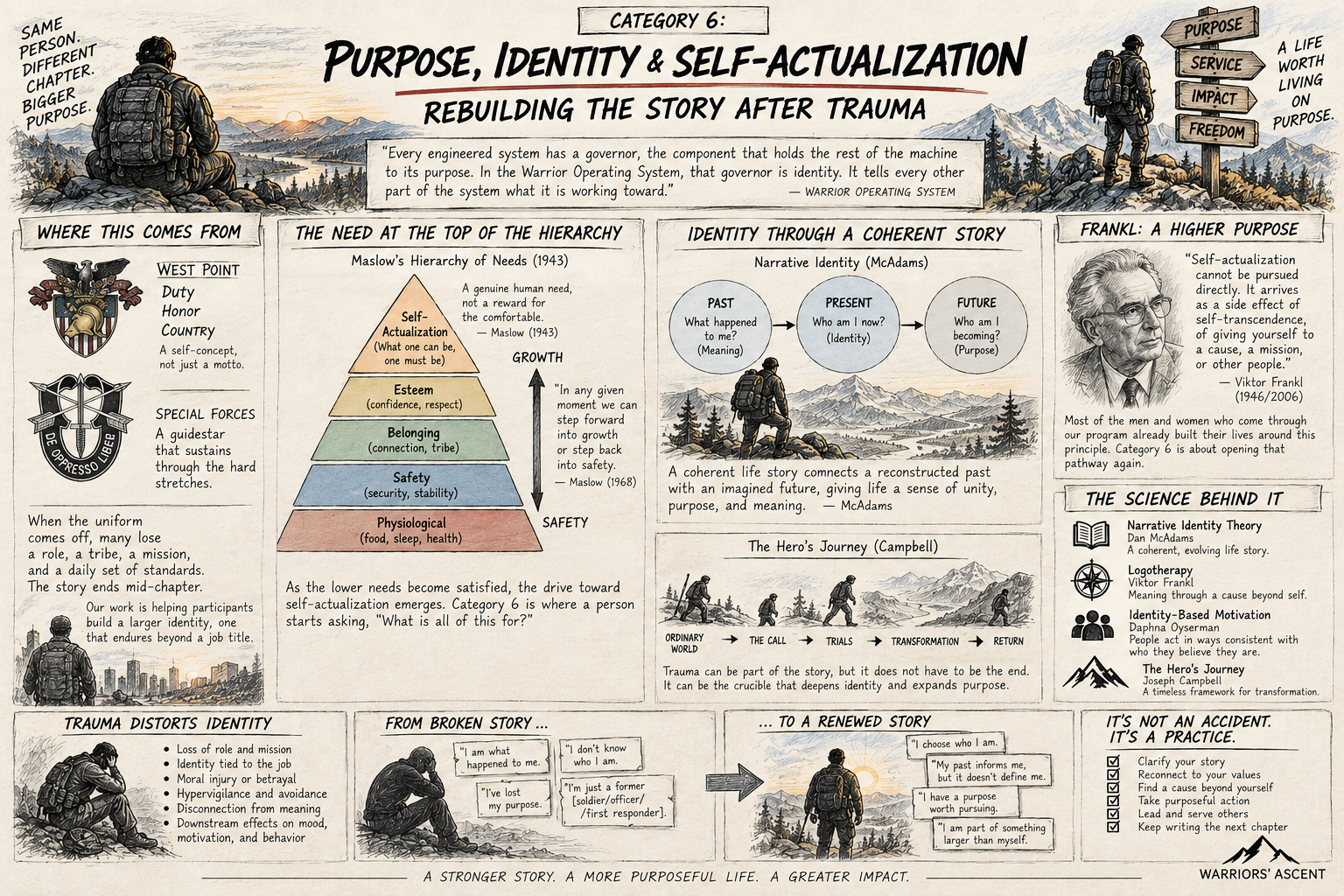
Every engineered system has a governor, the component that holds the rest of the machine to its purpose. In the Warrior Operating System, that governor is identity. Category 6, Purpose, Identity & Self-Actualization, tells every other part of the system what it is working toward, which is why it sits at the top of the WOS architecture and why the six-category series ends here. For a veteran or first responder rebuilding after trauma, a coherent identity is where healing finally lands. It is the difference between feeling better for a few weeks and knowing who you are for the rest of your life.
Where This Comes From
West Point hands every cadet three words, Duty, Honor, Country, and spends four years turning them from a motto into a self-concept. Special Forces does the same thing with De Oppresso Liber. Over the course of my career, I came to realize how much those guidestars mattered. A clear sense of who you are and what you stand for is what sustains motivation through the long, hard stretches, keeps focus on what matters when everything is competing for attention, and holds judgment steady when the stakes get high.
Many of our participants at Warriors’ Ascent grapple with the same problem after their careers end. For many of them, identity is inextricably linked to the job, the role, or the profession. When someone takes off the uniform or turns in the badge, they lose a role, a tribe, a mission, and a daily set of standards all at once, and almost nobody tells them that the story they’ve been living inside just ended mid-chapter. Add trauma, moral injury, or a career that ended badly, and that story can break entirely. A lot of what we call post-traumatic symptoms are the downstream effects of a person who no longer knows who they are or what their life is for. Part of our work is helping participants move beyond that, so they can see their identity, their role, and their value as something much larger than a job title.
Category 6 of the Warrior Operating System draws on three bodies of research to address that directly: Dan McAdams’ narrative identity theory, Viktor Frankl’s logotherapy, and Daphna Oyserman’s identity-based motivation. It also borrows one of the oldest narrative frameworks we have, Joseph Campbell’s hero’s journey. Together they help participants rebuild a coherent self-story, restore meaning beyond trauma, and carry that identity home in a form that lasts.
The Need at the Top of the Hierarchy
Abraham Maslow placed self-actualization at the top of his hierarchy of needs in 1943, and he was clear that he meant a genuine human need rather than a reward reserved for the comfortable. His phrasing was blunt: “What a man can be, he must be” (Maslow, 1943). In more modern language, what one can be, one must be. A person living well below their capacity feels that gap as restlessness and discontent even when every other need is met, because some part of them knows the distance between who they are and who they could be.
The hierarchy also explains the sequencing inside WOS. Maslow argued that needs for safety, belonging, and esteem press hardest when they go unmet, and that the drive toward self-actualization emerges most fully as those lower needs become reasonably satisfied. That maps closely onto the structure of the framework. The physiological, regulatory, and belonging work of the earlier categories stabilizes the foundation, and Category 6 is where a person starts asking what all of that stability is for.
Maslow later described the psychological choice underneath this as a tension between safety and growth (Maslow, 1968). In the line most often attributed to him, in any given moment we can step forward into growth or step back into safety. Trauma loads that choice heavily in one direction. Hypervigilance, avoidance, isolation, and emotional shutdown are all ways of stepping back into safety, and in a nervous system that has learned the world is dangerous, every one of them feels rational. Growth requires stepping toward the very things the system has been trained to avoid, and that step is much easier to take when a person can see who they are stepping toward.
Viktor Frankl added a correction to Maslow that matters a great deal for this population. Frankl argued that self-actualization cannot be pursued directly as a goal, and that it arrives as a side effect of self-transcendence, of giving yourself to a cause, a mission, or other people (Frankl, 1946/2006). Most of the men and women who come through our program already built their lives around that principle. They served something larger than themselves, and when the service ended, the pathway to self-actualization closed along with it. Category 6 is about opening it again.
Rebuilding a Coherent Self-Story
McAdams defines narrative identity as the internalized, evolving story a person constructs to connect a reconstructed past with an imagined future, giving life a sense of unity and purpose (McAdams, 2001; McAdams & McLean, 2013). Put simply, we understand who we are through the story we tell about how we got here and where we’re headed. That story is psychologically real. It shapes mood, motivation, and the choices a person believes are available to them.
Trauma attacks that story at its structure. It splits a life into before and after, and very often the “after” chapter gets written in the language of damage. McAdams and his colleagues identified two patterns that show up in the way people narrate turning points. In a contamination sequence, something good turns bad and stays bad, and the story bends toward loss from that point forward. In a redemption sequence, something bad leads to something good, whether growth, insight, connection, or a new sense of purpose. Their research found that people whose life stories carry more redemption sequences report greater well-being, and people whose stories carry more contamination sequences report more depression (McAdams, Reynolds, Lewis, Patten, & Bowman, 2001).
Redemption in this sense has nothing to do with pretending the worst day of your life was secretly good. The event stays what it was. What changes is the meaning a person is able to build afterward, and whether the story can move forward from that event instead of getting stuck on it. That is where Frankl becomes indispensable. Frankl, a psychiatrist who survived Auschwitz and three other camps, identified three sources of meaning: creating a work or doing a deed, experiencing something or encountering someone, and the attitude a person takes toward suffering they cannot avoid (Frankl, 1946/2006). The third source is the one trauma survivors rarely hear about and most need. It holds that even in circumstances a person did not choose and cannot undo, the stance they take toward them remains theirs. Frankl borrowed a line from Nietzsche to summarize the whole idea: a person who has a why to live for can bear almost any how.
The pilot study published on our program in the Journal of Psychotherapy Integration contains a finding that belongs squarely in this category. After the program, veterans’ scores on a measure of moral injury, the sense of having violated one’s own values, went up rather than down (d = 0.59). Liese and Monley’s interpretation was that veterans became more willing to acknowledge moral injury they had been avoiding (Liese & Monley, 2023). From a systems perspective, that reads as a threshold effect: once avoidance breaks down, material that had been held below the surface of awareness crosses into view. Category 6 is where that material gets worked. Activities like the Ceremony for the Dead and Leap of Faith exist precisely so that grief, guilt, and loss can be named, honored, and written into a story that still has a future in it.
The Hero’s Journey
If McAdams explains how people story their lives, Joseph Campbell supplies one of the oldest templates for telling that story well. In The Hero with a Thousand Faces, Campbell compared myths from cultures all over the world and found the same underlying structure repeated so consistently that he called it the monomyth (Campbell, 1949/2008). The hero answers the call to adventure, descends into the unknown world, walks the road of trials, and faces the supreme ordeal. Then comes apotheosis, the transformation into something greater, and finally the return with the boon, bringing what was won back to the known world to make it a better place. Campbell reduced it to three movements: departure, initiation, and return.
The two frameworks complement each other. McAdams gives us the psychology and the evidence, showing that the shape of a person’s story predicts how well that person lives. Campbell gives us the shape itself. The monomyth is essentially a redemption sequence written at the scale of an entire life, one where the ordeal is the price of transformation instead of the end of the story. It also speaks to veterans and first responders in a language that fits their experience far better than clinical vocabulary does. Most of them answered a call, crossed a threshold most people never cross, and went through trials that changed them permanently.
Campbell is most useful, though, on the part of the journey that gets the least attention. He treated the return as one of the hardest stages of the adventure, and wrote about heroes who refuse to come back, who have to be rescued from beyond the threshold, or who return to find that the ordinary world cannot understand what they have seen. That is a remarkably accurate description of the transition out of military service or a public safety career. Many of our participants are living in a story that stalled somewhere in the return, still carrying what they brought back from the ordeal and unsure where it fits. Campbell called the hero who completes the journey the master of the two worlds, someone able to move between the world of the ordeal and the ordinary world without losing either one, and able to offer what was learned along the way in service to others. In narrative terms, that is exactly what our program is working toward. To help participants see their own lives through that frame, we show the class Finding Joe (2011), a documentary on Campbell and the hero’s journey, as inspiration. It puts their experience inside a pattern as old as storytelling itself, and it gives them a way to see the ordeal as a chapter in a larger story instead of the end of one.
The same arc describes the week itself. A participant answers the call to come to Warriors’ Ascent, descends into the grief, guilt, and loss that have been kept at a distance, does the hard work of the cohort alongside people who understand, and goes home changed. What happens after the return is the real measure, and we have already watched it play out. This September, Team Warriors’ Ascent ran the Pikes Peak Ascent half marathon to the 14,115-foot summit as part of our Hero’s Journey Race Series. Three of those runners came through our program, went home, and rebuilt their lives before taking on the mountain: Tim, a US Army engineer, firefighter, and WA mentor; Brad, a US Marshal; and Dave, a US Navy veteran, certified strength and conditioning coach, and ultramarathoner who now serves as Team WA’s training coach. Dave’s and Tim’s path is Campbell’s return with the boon in its most literal form. They came through the program as participants, and both now spend time preparing the next group of graduates for the climb.
Carrying the Story Home
A rebuilt story only matters if it holds up after the cohort ends, and Daphna Oyserman’s research on identity-based motivation explains why some changes last and others fade (Oyserman, 2009, 2015). Her central finding is that people are ready to act on behavior that feels identity-congruent, something “people like me do,” and they start that behavior more readily and sustain it longer. Identity also shapes how people read difficulty. When a task fits who we believe we are, a hard day reads as a sign the effort matters. When it doesn’t fit, the same hard day reads as proof the effort was never meant for us, and we quit. Her interventions helping students connect their future selves to present-day actions produced measurable gains in grades and attendance (Oyserman, Bybee, & Terry, 2006).
That mechanism is the missing link from our Category 3 article on motivation and discipline, where we argued that discipline outlasts motivation because it runs on identity and structure instead of mood. A graduate who goes home with a clear identity interprets the early alarm, the hard conversation, or the difficult anniversary as part of who they are, and they don’t have to re-litigate their recovery every morning. Identity becomes the highest-level if/then in the whole system: if I am this kind of person, then this is what I do.
The Coat of Arms: Identity You Can See
One of the most powerful exercises in our program takes all of this theory and puts it in a form a warrior already understands. Each participant designs a personal coat of arms, modeled on military heraldry. Every Army unit carries a distinctive insignia, and many carry a full coat of arms and motto designed by the Institute of Heraldry. The West Point coat of arms, for example, bears the helmet of Pallas Athena above a Greek sword, with Duty, Honor, Country on the scroll beneath. These symbols exist because military institutions understood long before psychologists did that identity has to be made visible to be held under stress.
The exercise has three elements:
| Element | What participants create | What it does in WOS |
|---|---|---|
| The shield | Symbols of what matters most to them: a badge for law enforcement, an axe or ladder for firefighters, crossed arrows for Special Forces, a lamp for knowledge, a Greek or Roman helmet for soldiership and service | Externalizes identity, making roles and loyalties concrete instead of abstract |
| The virtues | Three or four virtues rendered in Latin, true to the heraldic tradition: prudentia(prudent, wise decision-making), fortitudo (fortitude, resilience, grit, mental toughness), gravitas (solemnity, dignity, seriousness of purpose), and others such as iustitia or temperantia | Clarifies values and turns them into named standards a person can measure themselves against |
| The motto | A single line that compresses identity into a rule, such as vincit qui se vincit, “he conquers who conquers himself” | Creates an identity-level if/then that can be recalled under pressure, when deliberation is least available |
Putting the virtues in Latin serves a purpose beyond tradition. It slows people down. Choosing between fortitudo and temperantia forces a participant to think carefully about what each word actually demands of them, and the result carries a weight that a list of adjectives on a worksheet never would.
The coat of arms is narrative repair made physical. Veterans and first responders who arrive convinced that trauma has erased everything they used to be find themselves drawing the symbols of what they still are: the service they gave, the people they love, the virtues they never actually lost. Many participants discover in the process that the story of their lives has more redemption in it than they had allowed themselves to see. The shield goes home with them, and it gives them something concrete to return to on the hard days, when the old story starts pulling them back. That fits the thesis we started this series with. We are handing participants something they can carry and run on their own, without needing us in the room.
Why the Arc Closes Here
Read the six categories as a system and the reason Category 6 comes last becomes clear. Energy and physiology supply the biological capacity. Cognitive mastery and emotional regulation keep judgment intact under stress. Motivation and discipline convert intention into durable action. Planning and decision-making turn that action into coordinated execution, and belonging and tribe stabilize the social field that all of it depends on. Category 6 sits above every one of them, giving the rest of the system something worth regulating toward.
It also carries the most dangerous failure cascade in the framework. When identity fractures through moral injury, betrayal, or the loss of a role, motivation collapses, daily functioning decays, and eventually the relationships around that person suffer with it. Identity erosion is also one of the slowest and quietest failures in the system, with long delays between the first fracture and any visible collapse. That delay is why so many people seem fine right up until they aren’t, and it’s why we treat identity as something worth measuring and protecting instead of something assumed to be stable.
This category is where healing lands. A veteran or first responder who leaves our program with a coherent story, a recovered sense of meaning, and a clear picture of who they are stepping toward has completed the return Campbell described and made the move Maslow described, forward into growth instead of back into safety.
References
Campbell, J. (2008). The hero with a thousand faces (3rd ed.). New World Library. (Original work published 1949)
Frankl, V. E. (2006). Man’s search for meaning. Beacon Press. (Original work published 1946)
Liese, B. S., & Monley, C. M. (2023). Feasibility of multimodal group treatment for veterans with PTSD, depression, and high-risk drinking: A pilot study. Journal of Psychotherapy Integration. Advance online publication. https://doi.org/10.1037/int0000309
Maslow, A. H. (1943). A theory of human motivation. Psychological Review, 50(4), 370-396.
Maslow, A. H. (1968). Toward a psychology of being (2nd ed.). Van Nostrand.
McAdams, D. P. (2001). The psychology of life stories. Review of General Psychology, 5(2), 100-122.
McAdams, D. P., & McLean, K. C. (2013). Narrative identity. Current Directions in Psychological Science, 22(3), 233-238.
McAdams, D. P., Reynolds, J., Lewis, M., Patten, A. H., & Bowman, P. J. (2001). When bad things turn good and good things turn bad: Sequences of redemption and contamination in life narrative and their relation to psychosocial adaptation in midlife adults and in students. Personality and Social Psychology Bulletin, 27(4), 474-485.
Oyserman, D. (2009). Identity-based motivation: Implications for action-readiness, procedural-readiness, and consumer behavior. Journal of Consumer Psychology, 19(3), 250-260.
Oyserman, D. (2015). Pathways to success through identity-based motivation. Oxford University Press.
Oyserman, D., Bybee, D., & Terry, K. (2006). Possible selves and academic outcomes: How and when possible selves impel action. Journal of Personality and Social Psychology, 91(1), 188-204.