Blog Post
"Don't Be Afraid. Be Vulnerable."
October 29, 2026
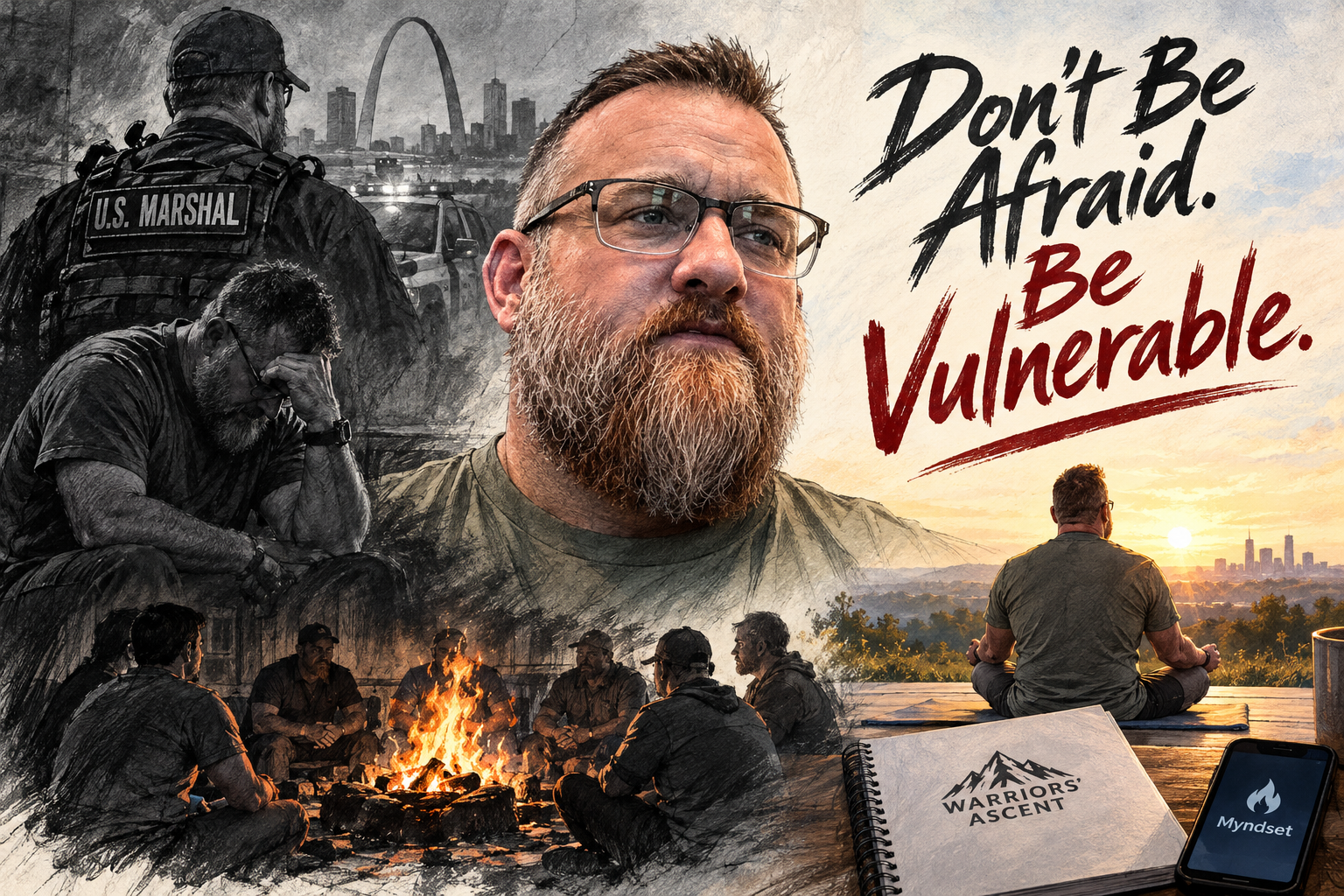
Brad Owens has spent 24 years in law enforcement. He served nine years as a police officer in St. Louis City and the last fifteen on the federal side as a U.S. Marshal. On November 6 he will take the stage as the keynote speaker at the Warriors’ Ascent Celebration Dinner.
Before he was our keynote, Brad was a member of one of our cohorts. He sat down with us afterward and told his story on camera. Watch it here, then read on.
Over the past two weeks we have shared the numbers behind our work. Brad’s story shows what those numbers look like inside one life. We share it with his permission and with deep gratitude for his willingness to be seen.https://youtu.be/0pecN854f9o
Before: Twenty-Four Years of Pushing It Down
Brad came up in a police culture that had little room for mental health. “We were always taught that whatever you’re dealing with, you push it down,” he says. “You don’t show emotion. You move on to the next call.”
He did that for a long time. “I have been struggling with several issues for many, many years and kept pushing everything down,” Brad says. Over a 24-year career he went through counseling, critical incident debriefs, and other programs. None of them reached the problem. “You really learn how to cope in negative ways,” he says.
By the time a co-worker who had graduated from Warriors’ Ascent suggested he apply, Brad knew he needed something different. He wanted tools to get his struggles out in the open, talk about them, and deal with them. He wanted it for himself and for the people around him every day, especially his family.
Looking back, he puts it plainly. “I was on the brink of destruction, at rock bottom, before going to Warriors’ Ascent.”
During: Five Days That Changed the Direction
Brad was apprehensive on the drive from St. Louis to Kansas City. “The advice that I was given prior hasn’t helped me,” he says, “so I didn’t know what to expect.” He felt the stress building in his body. He kept going because of his commitment to himself, his family, his friends, and the co-worker who had vouched for the program.
The nerves did not last. “When I drove up and walked through the doors, I knew right away that it was going to be a positive experience,” he says. Meeting the other members of his cohort at check-in, he felt comfortable almost immediately.
What set Warriors’ Ascent apart, Brad says, was the camaraderie. In past debriefs with co-workers he still felt isolated, because no one was willing to look vulnerable in front of the people they work with. “This is the opportunity to do that,” he says, “because you need to be vulnerable to fix yourself.”
He remembers the curriculum, the yoga, and the mix of physical and mental work. He also remembers the evening when participants wrote down what they wanted to let go of and threw it into the fire. And he credits the format itself. “Having to stay there for the five days is incredibly crucial to the success of that program.”
After: A Daily Practice
The real test of five days is what a graduate carries home. Brad started putting the tools into practice as soon as he got back, and two of them became daily habits.
The first is yoga. “It’s an essential part of my everyday routine now,” he says. “I get up in the morning, and that’s how I start my day.” It is his time to wake up his body and mind and work through whatever problems he is facing.
The second is the Myndset app. When he is struggling and no one is around to talk to, he opens the app, talks or texts through it, and works through its classes. He describes the moment he completes his daily session: “Every time that I get to that hundred percent mark and the flame goes up, that sense of relief just comes over, and I’m able to release the things that were bothering me.”
He keeps the program manual on his nightstand. He has started the Warriors’ Ascent digital course and returns often to System 1 and System 2 thinking, which he calls “a great concept.” For someone who learned to cope in negative ways over 24 years, he says, learning these skills later in his career “has been incredible.”
Leaving With Hope
Brad left Warriors’ Ascent “with a sense of hope,” and he has not stopped talking about it since. “I’m not ashamed that I went through there,” he says. “I’m actually very thankful that I did.”
He sees the stigma in law enforcement starting to change, and he believes it has to. Holding everything in, he says, harms your physical and mental health and makes you cynical. His message to any officer, deputy, or veteran who feels alone after critical incidents is direct:
“Don’t be afraid. Don’t be scared. Be vulnerable, go into it with an open mind, and get all the experience you can from that five days, because it’s completely worth it.”
He has a message for supporters too. “If you can afford to donate to keep this program going, it’s very critical,” Brad says. “It’s critical to my survival. I can tell you that firsthand, and I am sure that it is the same for a lot of the people that have gone through.”
One Story Behind the Numbers
Brad’s experience matches a pattern we can measure. A peer-reviewed pilot study of our program, conducted with the University of Kansas Cofrin Logan Center for Addiction Research and Treatment and published in the American Psychological Association’s Journal of Psychotherapy Integration (Liese & Monley, 2023), found statistically significant positive outcomes for graduates.
The study shows the change across a group. Brad shows what that change looks like on a yoga mat first thing in the morning, or in a hard moment with no one around to call. Demand is rising too. Applications to Warriors’ Ascent are up more than 150 percent over the same period last year, and more veterans and first responders like Brad are asking for a seat than we can currently serve.
Hear Brad in Person, and Help the Next Warrior Ascend
Join us on Friday, November 6, at Fiorella’s for the 2026 Warriors’ Ascent Celebration Dinner, where Brad will deliver this year’s keynote. It is an evening to honor our graduates and the community that makes their journey possible.
- Attend: Reserve a seat or host a table. [Link to tickets]
- Give: Sponsor a seat in an upcoming cohort so another veteran or first responder can walk through the doors the way Brad did.
- Share: Brad tells everyone who will listen. Send this story to someone who wears a badge or served in uniform. It may be the push they need to apply.
Watch Brad’s full testimonial on our YouTube channel: youtu.be/0pecN854f9o