Blog Post
Seeing the Human Being as a System of Systems: What West Point and the School of Advanced Military Studies Taught Me About Systems Thinking
August 17, 2026
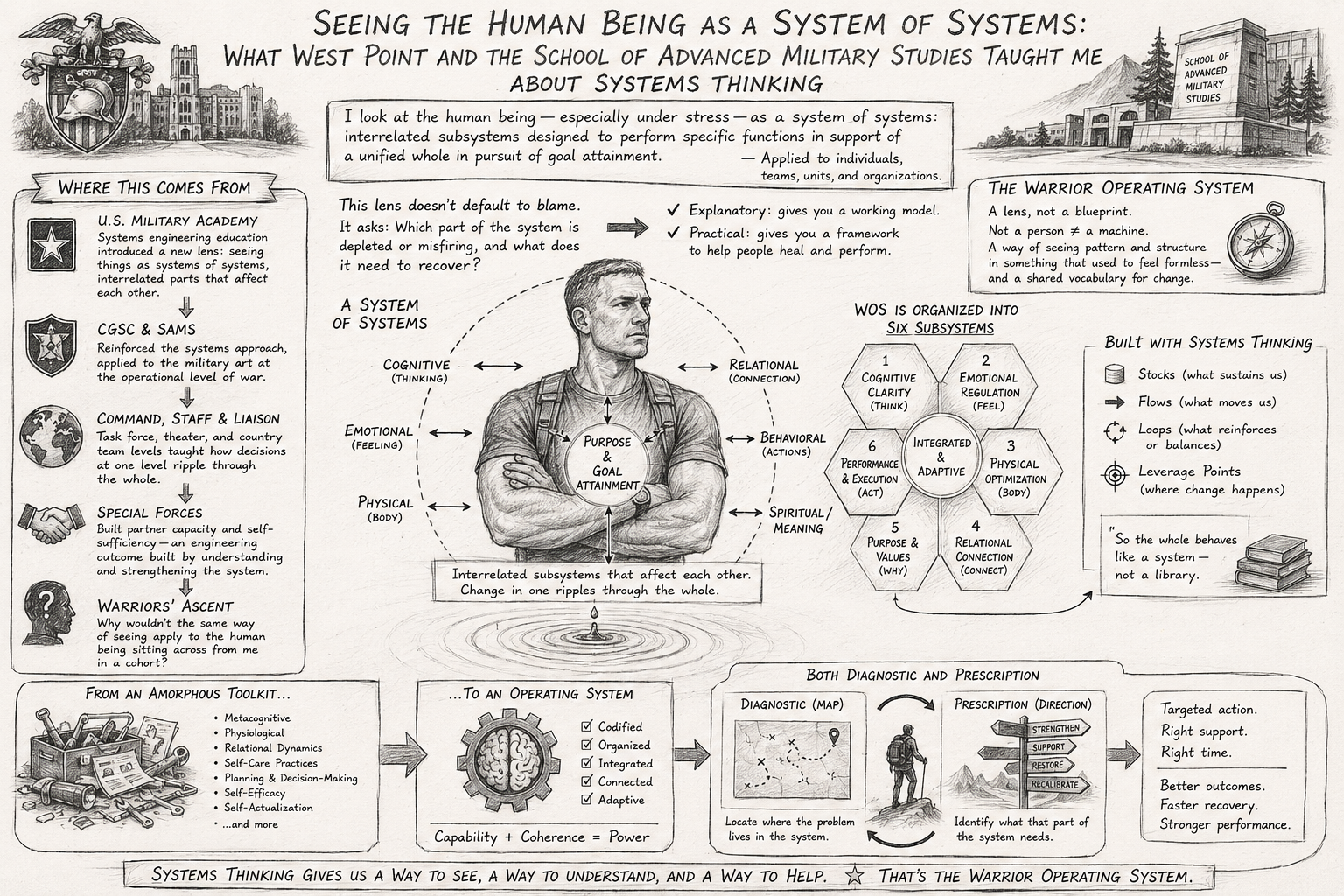
Early in my career, I started looking at the infantry soldier, especially a special operator, as a weapon system: an interrelated series of subsystems designed to perform specific functions in support of a unified whole in pursuit of goal attainment. That same lens scaled up naturally, from the individual to teams, units, and organizations. I carried it into everything that came after. Systems thinking was reinforced at the Command and General Staff College and the School of Advanced Military Studies as applied to the study of warfare, and for the last several years I’ve been applying it to something most people never think to view through that kind of lens: a human being under stress.
That way of looking at things has proven useful for more than one reason. It doesn’t default to blame and isn’t judgment-laden. When someone is struggling, the easy explanation is that they lack motivation, commitment, or ability. Thinking in terms of a system of systems asks a more precise question instead: which part of the system is depleted or misfiring, and what does it need to recover? I’ve found that approach both explanatory, in that it gives you a working model, and practical, since it gives you an actual framework for something that used to feel amorphous and almost intangible.
That’s the thinking behind the Warrior Operating System. I don’t mean that as a tidy metaphor borrowed from the corporate world just to make trauma recovery sound more sophisticated. The discipline underneath it is real, built out of an actual career in the military and tested for decades in operational environments. But when I apply that discipline to a human being, I’m using it as a lens, not a blueprint. A person isn’t literally a machine, and no framework should pretend otherwise. What systems thinking offers is a way of seeing pattern and structure in something that used to feel formless, and a shared vocabulary for talking about it, applied directly to how we help veterans and first responders heal and perform.
Where This Comes From
My systems engineering education at the United States Military Academy introduced me to a new way of thinking: seeing things as systems of systems, interrelated parts that affect each other, rather than individual pieces standing on their own. It wasn’t just a technical skill. It was a new lens: understanding how systems work, and how to deliberately optimize them.
My continuing education at the Command and General Staff College and the School of Advanced Military Studies reinforced that same systems approach, applied now to the military art at the operational level of war. My subsequent service as a commander, staff officer, and liaison at the task force, theater, and country team (US Embassy) levels only sharpened that perspective further, forcing me to see how decisions at one level rippled through the whole.
I carried that discipline into Special Forces, where a huge part of the job was building partner capacity: teaching local forces to sustain themselves rather than depend on us indefinitely. Self-sufficiency isn’t a slogan in that world. It’s an engineering outcome, built deliberately by understanding the system you’re trying to strengthen.
By the time I started building Warriors’ Ascent, I’d spent most of my career applying systems thinking to organizations, teams, and decisions. The question that built WOS was simple: why wouldn’t the same way of seeing apply to the human being sitting across from me in a cohort?
From an Amorphous Toolkit to an Operating System
The Warrior Operating System didn’t start as a framework. It started as a stack of course material that had grown enormous over years of building and refining our curriculum. By the time we sat down and looked honestly at everything we were teaching, it spanned the metacognitive, the physiological, relational dynamics, self-care practices, planning and decision-making, self-efficacy, self-actualization, and a half dozen other domains besides. Every piece of it was purpose-built and designed to elicit learning outcomes and behavioral objectives. The challenge was presenting it in a manner that was logical and readily understood, and not just an amorphous assemblage of mental frameworks, mindsets, and self-care practices.
That’s an organizing problem I recognized immediately, because it’s the same problem you run into with any complex body of work built piece by piece without an architecture behind it. You end up with capability but no coherence. So we borrowed a systems lens to codify it: we organized every tool, every practice, every piece of curriculum into six subsystems and built the connective tissue between them, thinking in terms of the stocks, the flows, the loops, the leverage points, so the whole thing behaves like a system instead of sitting there as a library.
That codification is what gives WOS its actual power, and it’s the part most people miss on first exposure. It functions as both a diagnostic tool and a prescription. A participant who isn’t functioning well doesn’t have to sort through years of accumulated material guessing at what might help. Using the system as a map, they can locate roughly where the problem lives, whether it looks like a depleted reserve, a spiral that’s reinforcing itself, or a point of leverage nobody’s pulled yet, and then apply the specific practice built for that kind of struggle. Diagnosis and remediation live in the same framework. A toolbox just sits there. This tells you which tool to pick up, and why.
A Human Being Is Not a Set of Symptoms
Most trauma recovery programs, however well-intentioned, treat the person in front of them as a collection of problems to manage: anxiety here, sleep issues there, anger somewhere else. That’s a bit like an engineer replacing a part every time a machine breaks down without ever asking why the machine keeps breaking down in the same place.
Warriors’ Ascent starts from a different premise. It helps to think of a human being as a nested system of systems: physiology, cognition, emotion, behavior, social belonging, and meaning, all interacting with each other constantly. The Warrior Operating System organizes those into six subsystems, and we borrow a set of ideas from system dynamics, the field Jay Forrester pioneered at MIT and the same discipline engineers use to understand everything from supply chains to power grids, as a lens for making sense of how a person holds up under stress. We’re not claiming a literal equivalence between a person and a machine. The vocabulary just helps us see structure in behavior that would otherwise look random, or worse, get chalked up to a character flaw.
Five Ideas From an Engineering Classroom That Help Explain What We See
Stocks. In any system, a stock is accumulated capacity: water in a reservoir, inventory in a warehouse. Picture a person’s inner reserves the same way: energy, cognitive bandwidth, emotional buffer, social capital, a sense of meaning. These aren’t gauges you can literally read off a dashboard, but they behave like a stock in the sense that matters most. Deplete them faster than you replenish them, and the system eventually falters, often without much warning until it does.
Flows. Every stock has something filling it and something draining it. Stress exposure, conflict, sleep disruption, and moral injury all act like withdrawals. Sleep, breathwork, emotional processing, connection, and cognitive reframing act like deposits. Seen this way, recovery isn’t just a matter of trying harder. It behaves more like a rate, and that rate has to outpace the rate of depletion, or the math doesn’t work no matter how much willpower someone brings to the problem.
Feedback loops. This is where most people’s eyes glaze over, and it’s also where the real insight lives. Think of a reinforcing loop as a spiral: rumination feeds anxiety, anxiety feeds more rumination. Avoidance offers short-term relief, which reinforces more avoidance, which shrinks a person’s life a little further each time. A balancing loop works the other way: something like reappraisal or a breath protocol that interrupts the spiral and brings the person back toward steadier ground. WOS trains those balancing patterns on purpose, because regulation, not suppression, is what actually breaks a reinforcing loop.
Delays. Mechanical systems rarely fail in the moment; the failure often shows up late, after a delay has quietly masked what was wearing down underneath. That’s why someone can look fine through months of sleep debt and mounting operational tempo, then seem to come apart out of nowhere. It wasn’t sudden. It was delayed, and nobody was watching the leading indicators. We teach the same habit of attention: track sleep consistency, irritability, and isolation before they become a crisis, not after.
Leverage points. Donella Meadows, one of the foundational thinkers in system dynamics, wrote about this directly in Thinking in Systems: A Primer: some points in a system produce outsized change relative to the effort invested, and most interventions land in the wrong place. The same holds for a person. Breath and physiology act like one of the fastest levers available, because they reset arousal almost immediately. Sleep resets several reserves at once. Purpose functions like a stabilizer underneath a person’s whole structure of goals and behavior. Thinking in terms of leverage, rather than guessing, is part of what separates a program that manages symptoms from one that changes the underlying pattern.
What This Looks Like When Someone Walks Through Our Door
Take a veteran who arrives having gone weeks on a sleep deficit while carrying a high operational tempo in civilian life. It’s a familiar pattern: high tempo drives sleep down, the shortfall creates a hidden strain that doesn’t show up right away, the delay masks the damage, and eventually errors and stress accumulate faster than the person can absorb them, which drives sleep down further. Left alone, that pattern tends to run itself. It doesn’t need the person’s cooperation to keep spinning.
Our job isn’t to talk someone out of that pattern through willpower. It’s to see the structure underneath it and intervene at the points that matter: protect sleep the way you’d protect any resource a whole system depends on, build early-warning signs so the person can see depletion coming before it becomes collapse, and set planning boundaries that throttle workload before it exceeds capacity. That’s the systems lens applied to a human being, and it tends to work the way it works in any complex system: change the structure around a behavior, and the behavior often changes with it.
Why Nobody Else Talks This Way
I don’t know another organization in trauma recovery that leans on a systems engineering lens this explicitly. Most programs, even excellent ones, describe what they do in terms of techniques and activities. We find that the system dynamics language and lexicon, the same field Donella Meadows wrote about in Thinking in Systems, is useful and explanatory, bordering on metaphorical: stocks, flows, loops, delays, leverage points, borrowing the same vocabulary an engineer would use to make sense of why a complex system is underperforming.
That distinction isn’t really about winning over any one audience. The point isn’t to translate what we do into language that happens to land well with engineers and operators, though it often does. It’s that a systems approach offers an altogether different way of explaining human healing, one most people in this field have never been offered. “We build capacity, not dependency” is a mission statement. “We think about emotional buffer the way you’d think about a reserve, and about recovery as a rate that has to outpace the rate of stress coming in” is something closer to a working explanation, a more comprehensive way of seeing the whole picture rather than a piece of it. That’s what we’re really after: not a framework built to persuade a particular audience, but a more complete and more usable way of understanding what’s happening in a person, one we think turns out to be more accessible and easier to accept than most of the alternatives.
What’s Ahead
Next in this series, I’ll start walking through each of the six categories in the Warrior Operating System individually, beginning with cognitive mastery and emotional regulation. Each one gets the same treatment: the science behind it, the reserve it draws on, and the patterns it’s built to interrupt. This West Point background isn’t a biography detail. It’s the way of seeing underneath everything Warriors’ Ascent does, and I want you to see the whole architecture, not just the outcomes it produces.
References
Further reading: John D. Sterman, Business Dynamics: Systems Thinking and Modeling for a Complex World (Boston: Irwin/McGraw-Hill, 2000), a standard graduate text on applying system dynamics, stocks and flows, and feedback structure to complex real-world behavior.
- Donella H. Meadows, Thinking in Systems: A Primer, ed. Diana Wright (White River Junction, VT: Chelsea Green Publishing, 2008). ↩