Blog Post
Sore From Smiling: What Two Graduates Say Warriors’ Ascent Gave Them
November 17, 2026
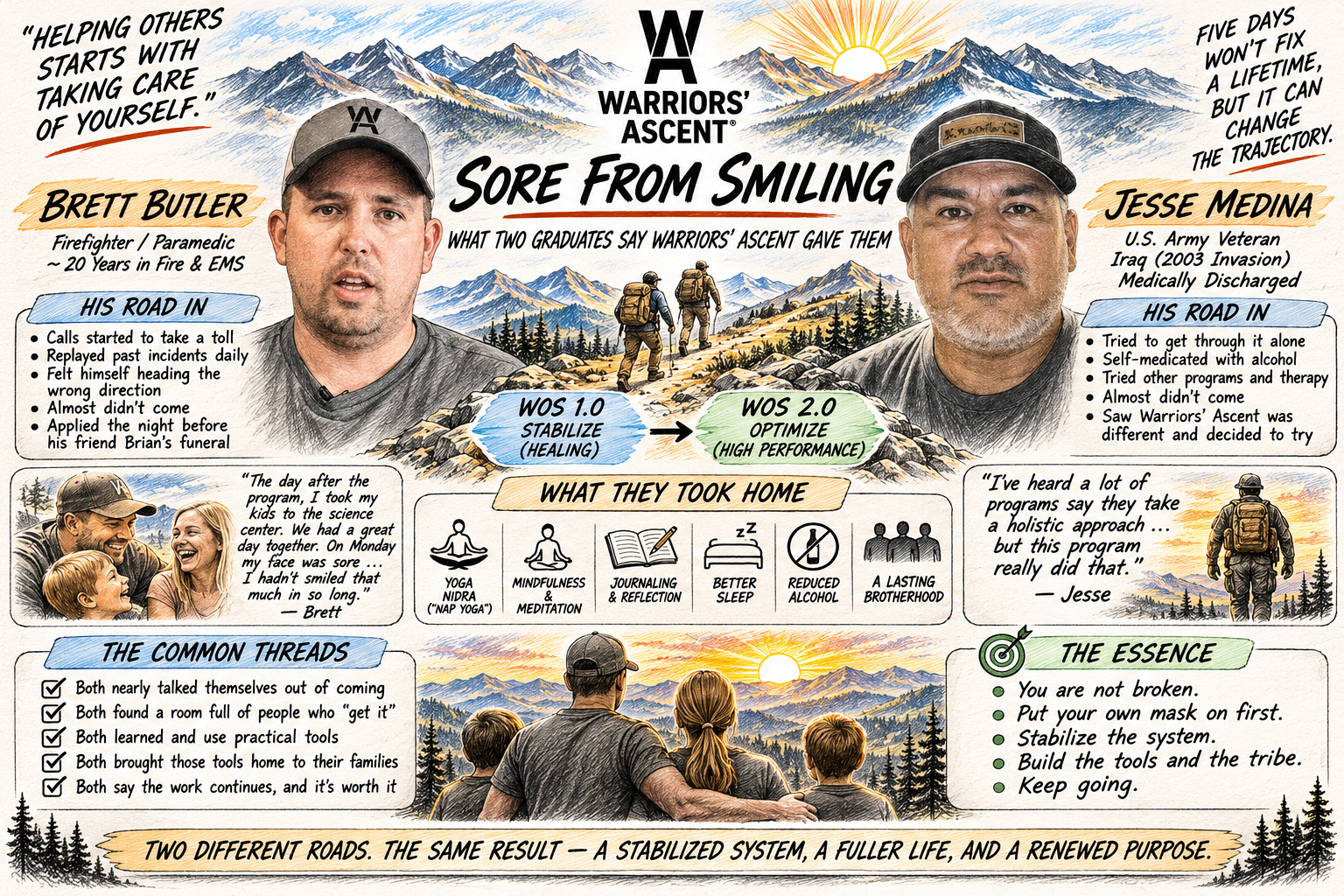
Graduate Stories | Video Testimonial Spotlight: Brett Butler and Jesse Medina
The day after Brett Butler graduated from Warriors’ Ascent, he took his kids to the science center. They had a great day together. On Monday morning his face was sore, and it took him a while to figure out why. He hadn’t smiled that much in so long that the muscles had forgotten how.
I’ve heard a lot of graduate stories over the years, and that one stays with me. Healing doesn’t always show up first on a symptom checklist. Sometimes it shows up as a sore face after a Saturday with your kids.
Brett is a firefighter and paramedic. Jesse Medina is an Army veteran of the Iraq invasion from St. Augustine, Florida. They came from different services, different states, and different kinds of trauma, and they share a single video on our channel. Watching them back to back, I was struck by how closely their stories line up, and by how clearly they describe what this program is designed to do.
[VIDEO EMBEDhttps://youtu.be/7BgqB8m7FtA]
Two Different Roads In
Brett spent about 20 years running fire and EMS calls, full-time and as a volunteer. Over time the calls started to get to him. On his drive to work, a reel of past incidents played in his head. The strain spread into his work and then into his home, and he could see things heading the wrong direction. One night he found himself driving around with no destination, feeling lost, with call after call rolling through his mind.
He picked up the phone and called his friend Brian Rousseau, a fellow first responder who had been through Warriors’ Ascent. They talked for over an hour. Brian then put him in touch with Kerry from our team, and Brett talked with Kerry for another 45 minutes that same night, trying to find a direction.
Jesse served ten years in the Army, including 14 months in Iraq beginning with the 2003 invasion, before he was medically discharged for injuries he sustained. He spent the years afterward trying to get through it on his own. By his own account, he self-medicated heavily with alcohol and managed it just well enough to be what he called a “fully functional alcoholic.” He had tried other routes, including government programs and traditional therapy, and they hadn’t worked for him. Warriors’ Ascent looked different, and he was ready to try something different.
“I Wasn’t Bad Enough”
Both men nearly talked themselves out of coming, and for the same reason.
Brett knew he had things he needed to deal with, but he believed other people were worse off and needed the spot more than he did. He didn’t want to take someone else’s place. Brian and Kerry both kept encouraging him, and Brett finally said he’d go “sometime.” A few months later, Brian died of COVID. The night before Brian’s funeral, Brett submitted his application. He was rostered into the very next cohort.
Jesse names the same trap from the other side. For people who have spent their lives as leaders in the military, in their departments, or in their families, he says, putting themselves first feels wrong. His answer is the one every flight attendant gives: put your own mask on before you help anyone else.
“If you’re even considering this, that means you probably already know that you need to be there.”
I hear the “not bad enough” belief more than any other objection, and I think it may be the single biggest barrier between our community and the help it needs. People who are trained to triage will triage themselves to the back of the line every time. Brian’s answer to Brett is the best one I know: you’re the one that matters, and you’re the one that wants the help, so go get it.
Showing Up Anyway
Neither man arrived feeling confident. Brett admits he was praying for two flat tires on the drive up, or a positive COVID test, anything that would give him a reason to go home. He knew from his conversations with Brian and Kerry that there would be hard days, vulnerability, and things he didn’t want to face. Jesse compared it to joining the military for the first time, walking into a group of strangers with no idea who he’d be bunked with.
What eased the tension for both of them was the room itself. Brett met Kerry in person for the first time after all those phone calls, and even though he was uneasy, he felt welcomed. He recognized a couple of faces in the cohort, and the faces he didn’t recognize still had a look he knew. Jesse found people who were like him, which told him for the first time that he wasn’t alone.
This is the most consistent finding in our program evaluation data. Graduates rate “being with others with similar experiences” 6.3 out of 7, the highest of any group process we measure. It’s also part of why only 2.9% of participants in our published study left before completing the program, compared with dropout rates of 16% to 36% in the PTSD treatment literature. Brett was praying for a flat tire and still stayed for all five days. The room is what keeps people there.
“This Program Really Did That”
Jesse said something about our approach that I want to pass along in his own words, because he’s earned the right to be skeptical of program marketing:
“I’ve heard a lot of programs say, ‘Oh, we do the holistic approach,’ and it sounds good on paper. But this program really did that.”
He described what that looked like in practice: early mornings that started with yoga, meals together, mindfulness training, and real attention to nutrition. In his words, “garbage in, garbage out.” He also described waking up next to men who are now his brothers. To this day they text each other every day. He said that bond formed the same way it did in the military. Nothing in the program told them to support each other. It happened on its own, and as a former leader, Jesse found he could be supported by others the same way he once supported his soldiers.
That kind of bond can’t be scheduled into a curriculum, but the conditions for it can be designed. That’s what the Warrior Operating System is built to do. It addresses the whole person, including the body, the nervous system, the mind, relationships, and purpose, because each of them affects the others.
What They Brought Home
Both men named the same tool first: yoga nidra, which Brett calls “nap yoga.” Plenty of firefighters and soldiers arrive certain they’ll never do yoga. Both of these men now use it regularly.
For Jesse, it changed his nights. Before the program his mind raced and he couldn’t fall asleep. Now he listens to a 30-minute yoga nidra session each night, and his wife says it helps her sleep too. He also sets aside at least 30 minutes in the middle of each day for meditation, using the guided recordings from the program. And he says his reduction in alcohol has been “amazing,” a change he credits to his own work and to the confidence the program gave him that he could do it. That matches what we see across our graduates, whose scores on a standard measure of high-risk drinking dropped significantly after the program.
For Brett, the tools became a family practice. His wife picked up the same habits, and now they journal together and meditate together at night. She also holds him accountable. On the nights after a hard day or a hard week, when he doesn’t feel like doing it, she calls him on it and they double down on self-care together.
An Honest Start
What I respect most about both testimonials is that neither man oversells it.
Brett is candid that he’s been consistent with some practices and not with others, and that he’s had to bounce back a couple of times. In his view, the program is what you make of it, and it takes work on the front end just to show up and more work on the back end to keep it going.
Jesse put it even more plainly:
“You don’t come there, get healed, hallelujah, you’re done. It’s a great jump starter into what your future could be again.”
He has since started his healing journey. He calls the life he has now the new normal, and he says it has changed things for his wife, his stepdaughter, his kids, and his friendships.
This is exactly what we want our graduates to understand when they leave. Five days won’t fix a lifetime, and we don’t claim it will. What five days can do is stabilize the system, give a person the tools to keep regulating it, and build the confidence to keep going. In the language of WOS, we stabilize before we optimize. Brett and Jesse are proof that stabilization can open the door to a fuller life, and that the people at home benefit along with them.
The Essence
If I had to boil both stories down, it would be this. Two men who each believed they weren’t worth the spot came anyway. They found a room full of people who understood them without needing an explanation. They took home a handful of practical tools and shared them with their wives. And they left with the honest understanding that the work was theirs to continue.
The result looks like a wife who sleeps better, a daily text thread among brothers, and a firefighter whose face hurts from smiling at the science center.
If you’re a veteran or first responder who has been telling yourself someone else needs the spot more than you do, take Brian’s advice: you’re the one that matters. Reach out to us at Warriors’ Ascent. If you’d like to help the next Brett or Jesse take that first step, consider supporting a cohort seat.
If you or someone you know is struggling, call or text 988 to reach the Suicide & Crisis Lifeline. Veterans can press 1 to reach the Veterans Crisis Line.