Blog Post
Teaching the Teachers: What CGSC and SAMS Taught Me About Building Minds, Not Just Bodies
November 10, 2026
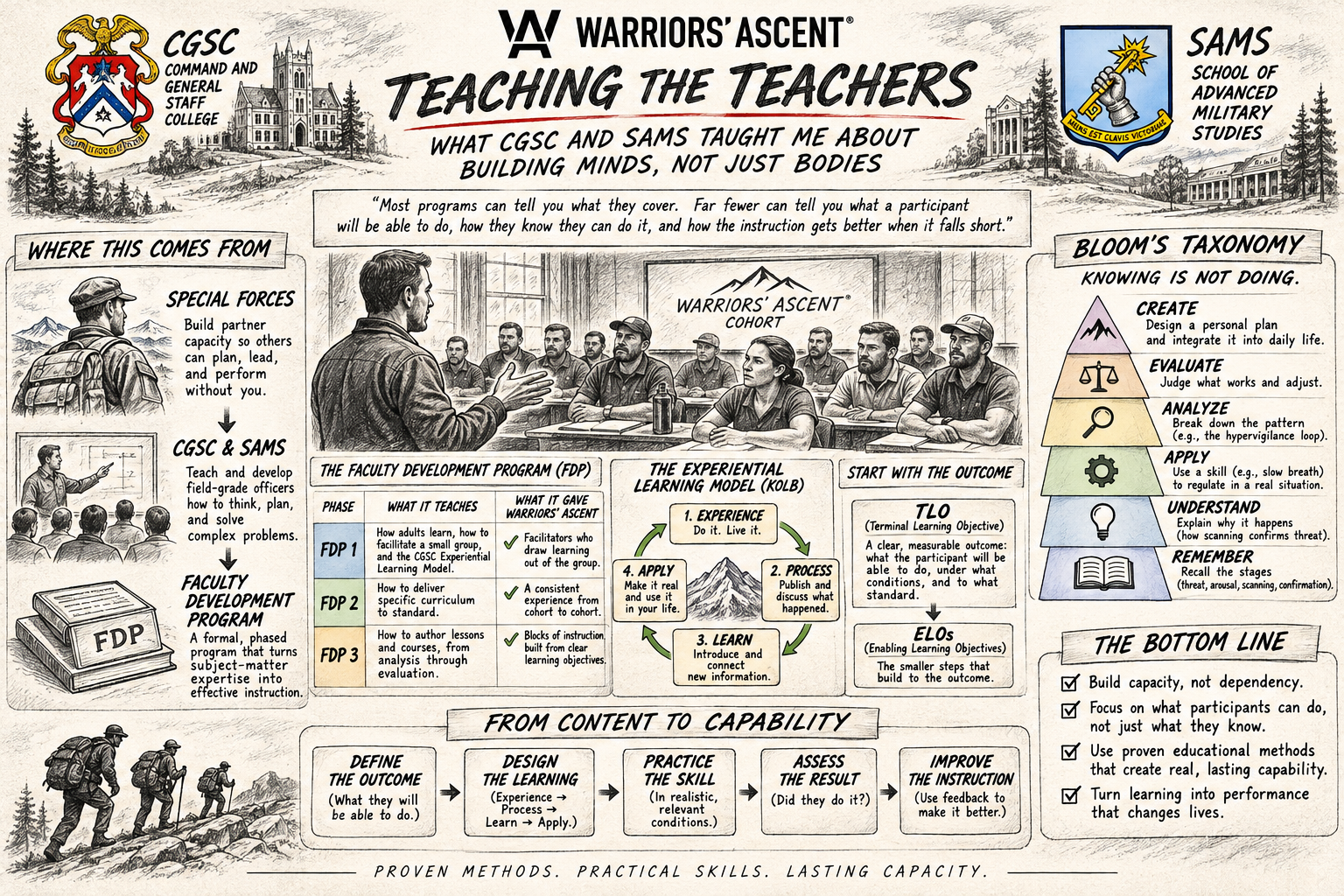
@Mike · Week 15, The Warriors’ Ascent Difference
Most programs that serve veterans and first responders can tell you what they cover. Far fewer can tell you what a participant will be able to do when the week is over, how they know the participant can do it, and how the instruction gets better when it falls short. At Warriors’ Ascent we work to answer all three, and our approach is informed by the same instructional design methodology the Army uses to educate its field-grade officers at the Command and General Staff College (CGSC) and the School of Advanced Military Studies (SAMS), where I served as both an instructor and a curriculum developer. This article explains that methodology and how it shapes the way our facilitators teach.
Where This Comes From
In the first article of this series I wrote that Warriors’ Ascent builds capacity, not dependency, and that the idea came out of my career in US Army Special Forces. Building partner capacity was a major portion of what we did. A Special Forces detachment is twelve soldiers, and twelve soldiers do not change the security of a region by fighting on their own. They do it by training, advising, and assisting a partner force until that force can plan and fight without them. I commanded a detachment for two years, and the measure of our success was always what our partners could do after we left.
That work makes you a teacher whether you planned on becoming one or not. You learn quickly that delivering a class and transferring a skill are different things, and that the only honest test of your instruction is whether the other person can perform when you are no longer standing next to them.
Later, as an instructor at CGSC and SAMS, my job was to teach our mid-level officer corps how to think and plan. The students were experienced majors, and the goal was to improve the quality of their thought and analysis, which is something a lecture cannot accomplish by itself. Fort Leavenworth is where I learned that teaching is a discipline with its own doctrine, and where I was formally trained in it.
Learning How to Teach
CGSC does not hand a new instructor a slide deck and a classroom. Subject-matter expertise gets you hired, and then the college teaches you how to teach through its Faculty Development Program (FDP), a sequence of phases that instructors and course authors move through.
| Phase | What it teaches | What it gave Warriors’ Ascent |
|---|---|---|
| FDP 1 | How adults learn, how to facilitate a small group, and the CGSC Experiential Learning Model | Facilitators who draw learning out of the group |
| FDP 2 | How to deliver specific curriculum to standard | A consistent experience from one cohort to the next |
| FDP 3 | How to author lessons and courses, from analysis through evaluation | Blocks of instruction built from learning objectives |
I completed all three phases, and I worked on both sides of the process, delivering instruction in the classroom and developing blocks of instruction as an author.
The Experiential Learning Model deserves a closer look, because it explains the rhythm of a day at Warriors’ Ascent. The model draws on David Kolb’s research on experiential learning (Kolb, 1984). It opens with a concrete experience, moves to the group publishing and processing what they noticed, and only then introduces new information. Learners then develop what that information means for them and apply it. Adults learn best when new material attaches to something they have just lived, so the experience comes before the explanation.
Start With the Outcome
The first rule FDP teaches a lesson author is to begin at the end. Before any content is chosen, you write a terminal learning objective (TLO), a single statement of what the learner will be able to do when the block of instruction is complete. In Army practice a TLO has three parts: the action the learner performs, the conditions under which they perform it, and the standard that defines success. That structure traces back to Robert Mager’s work on instructional objectives (Mager, 1962).
Beneath the TLO sit the enabling learning objectives (ELOs), the smaller steps a learner has to master along the way. If the TLO is the summit, the ELOs are the camps on the route up. Every reading, discussion, and exercise in the block has to serve an ELO, and every ELO has to serve the TLO. Anything that serves neither comes out, no matter how much the instructor enjoys teaching it.
This discipline changes the question an instructor asks. The natural question is “What do I want to cover?” The better one is “What must this person be able to do, and how will I know they can do it?”
For a program like ours, that shift carries real weight. A veteran who can define hypervigilance has learned something. A veteran who can catch their own arousal climbing in a crowded restaurant and bring it back down has gained a capability, and the capability is what changes a life.
Bloom’s Taxonomy: Knowing Is Not Doing
FDP uses Bloom’s Taxonomy to set the level of learning each objective requires. Benjamin Bloom and his colleagues published the original taxonomy in 1956, and Anderson and Krathwohl revised it in 2001 into six levels: remember, understand, apply, analyze, evaluate, and create. The verb in a learning objective declares the level, and the level dictates how the block has to be taught and assessed.
Here is how one piece of our curriculum, the hypervigilance loop I described in “The Six Loops That Run You,” climbs that ladder.
| Level | What the participant does |
|---|---|
| Remember | Recalls the stages of the loop: threat interpretation, arousal, scanning, and confirmation |
| Understand | Explains why scanning for danger keeps confirming the threat |
| Apply | Uses a slow breath with a long exhale to bring arousal down on cue |
| Analyze | Maps their own triggers and the situations where the loop runs |
| Evaluate | Judges whether breath or reappraisal gives more leverage in a given moment |
| Create | Builds a personal if/then plan to run after the week ends |
The lower levels are knowledge. The upper levels are where behavior changes, and they cannot be reached by lecture. They require practice with real stakes, coaching in the moment, and feedback from a group, which is why so much of our five days is spent doing instead of listening.
Many well-intentioned programs stop at understanding. Participants leave able to describe their struggles more accurately and no more able to change them. Writing objectives at the level of apply and above is how we hold ourselves to a higher standard than awareness.
Quality Control: The Post Instructional Conference
A lesson plan is a hypothesis about how people will learn, and it has to be tested. CGSC manages its curriculum through the Accountable Instructional System (AIS), a structured process that carries every course through analysis, design, development, implementation, and evaluation, then feeds what it learns into the next iteration. FDP 3 teaches authors to work inside that cycle.
One of its most useful mechanisms is the post instructional conference (PIC). After a block is taught, the instructors who delivered it sit down with its author and review it against the learning objectives. They look at what the assessments showed, what students said, where the lesson ran long or fell flat, and what should change before it is taught again.
We use facets of AIS at Warriors’ Ascent, and the PIC is the one I value most. It is our quality assurance and quality control. After a cohort, our team reviews the instruction against its objectives and asks the questions I learned to ask at Fort Leavenworth:
- Did participants reach the learning objective, and what evidence do we have?
- Where did the block lose people, and why?
- What did participants and mentors tell us?
- What do we sustain, and what do we change before the next cohort?
Veterans will recognize this as a close relative of the after-action review. It is how a program holds itself accountable for learning instead of assuming that good intentions produce good outcomes. It is also part of why our model could be studied at all. The pilot study published in the Journal of Psychotherapy Integration examined a defined multimodal group treatment, and a defined program has to exist before anyone can evaluate it (Liese & Monley, 2023).
How This Shapes Our Facilitator Model
All of this is encapsulated in the way we develop and deliver instruction at Warriors’ Ascent. Four practices follow directly from it.
Every block has a purpose we can state. Our instruction is developed to fulfill learning outcomes. Each block is built backward from what a participant should be able to do, and the activities inside it are chosen because they move participants toward that outcome.
Facilitators draw the learning out of the room. At CGSC the instructor in a small group is there to guide adults with hard-won experience toward their own conclusions. Our facilitators work the same way. Their job is to set up the experience, ask the question that opens it up, and connect what the group discovers to the tool being taught.
Experience comes before explanation. When a participant sees their own pattern drawn on a whiteboard as a loop, the science behind it lands differently than it would have in a lecture. They already have something lived to attach it to, which is the Experiential Learning Model doing its work.
The program improves by design. The post instructional conference means each cohort benefits from what the last one taught us. Changes to the curriculum are deliberate, tied to objectives, and based on evidence from the people in the room.
The model also extends past our staff. Graduates return as mentors to help with new cohorts, sharing how they applied the program and the tools they still rely on. A person who can teach a skill to someone else has reached the top of Bloom’s ladder. For me, that is the same thing I watched for in Special Forces: the moment a partner force begins training its own.
Why the Pedigree Matters
Nobody applies to Warriors’ Ascent because of our learning objectives, and no donor writes a check because of Bloom’s Taxonomy. They matter anyway, because they are the reason a five-day program can transfer skills that last.
A physical challenge is easy to design. Changing how a person thinks and responds under stress, and doing it reliably cohort after cohort, takes a methodology. Ours came from the institution the Army relies on to educate its field-grade leaders, and from years in Special Forces learning that the job is finished only when the other person can carry on without you.
If you are evaluating programs as a donor, a referral source, or a veteran deciding where to spend five days, ask each one what a graduate will be able to do at the end and how they know. We welcome that question.
Next in the series: The Warriors’ Ascent Podcast: Why We Started Telling Our Own Story.
References
Anderson, L. W., & Krathwohl, D. R. (Eds.). (2001). A taxonomy for learning, teaching, and assessing: A revision of Bloom’s taxonomy of educational objectives. Longman.
Bloom, B. S., Engelhart, M. D., Furst, E. J., Hill, W. H., & Krathwohl, D. R. (1956). Taxonomy of educational objectives: The classification of educational goals. Handbook I: Cognitive domain. David McKay.
Kolb, D. A. (1984). Experiential learning: Experience as the source of learning and development. Prentice Hall.
Liese, B. S., & Monley, C. M. (2023). Feasibility of multimodal group treatment for veterans with PTSD, depression, and high-risk drinking: A pilot study. Journal of Psychotherapy Integration. Advance online publication. https://doi.org/10.1037/int0000309
Mager, R. F. (1962). Preparing instructional objectives. Fearon Publishers.
U.S. Army Command and General Staff College. (n.d.). CGSC Bulletin No. 930. Curriculum development: The Accountable Instructional System. Fort Leavenworth, KS.
U.S. Army Command and General Staff College. (n.d.). CGSC Circular 350-1: College catalog. Fort Leavenworth, KS.