Blog Post
The Six Loops That Run You (Until You Learn to Run Them)
October 22, 2026
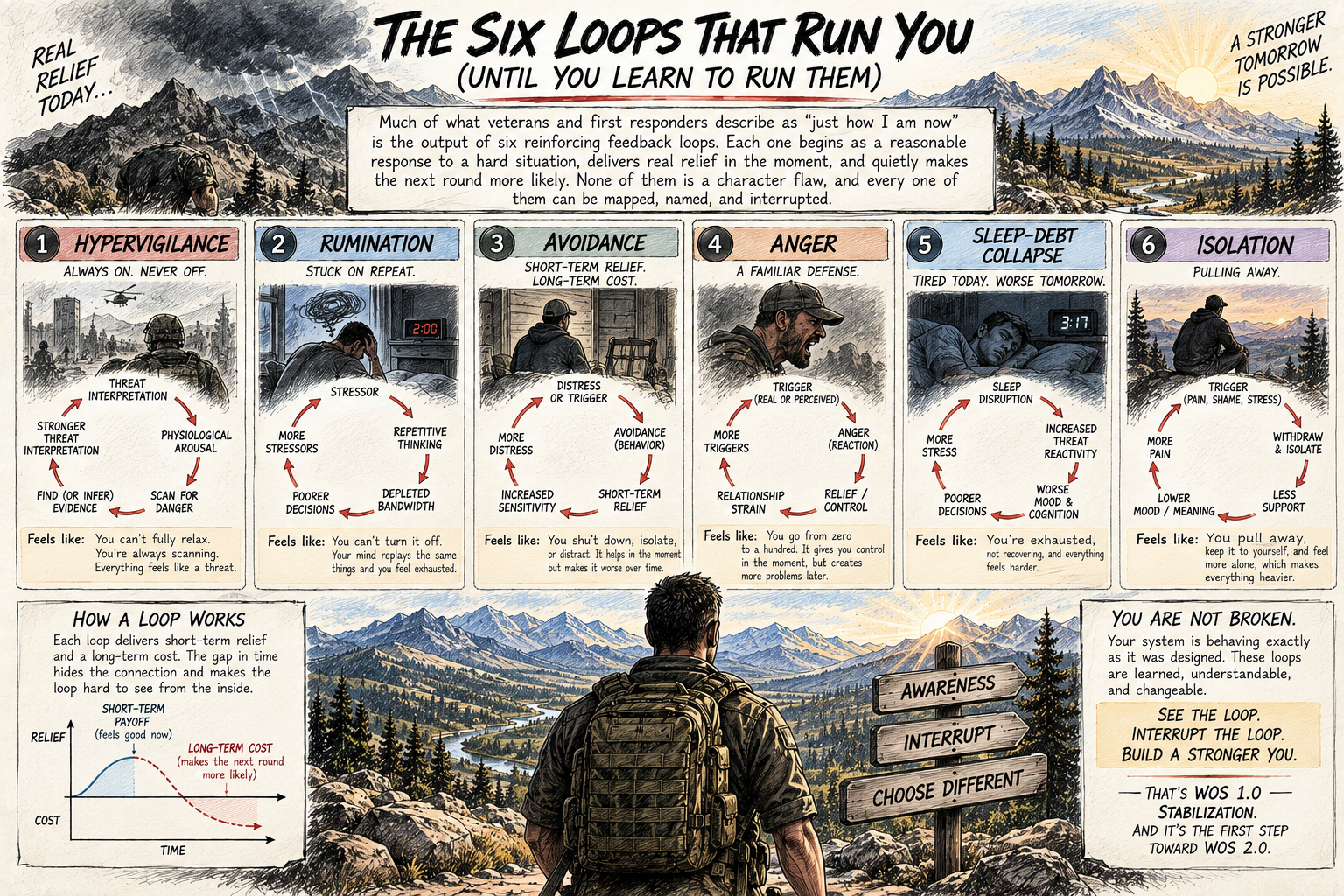
Much of what veterans and first responders describe as “just how I am now” is the output of six reinforcing feedback loops: hypervigilance, rumination, avoidance, anger, sleep-debt collapse, and isolation. Each one begins as a reasonable response to a hard situation, delivers real relief in the moment, and quietly makes the next round more likely. None of them is a character flaw, and every one of them can be mapped, named, and interrupted. Interrupting them is the core work of WOS 1.0, the stabilization layer of the Warrior Operating System, and this article is a field guide to all six.
Where This Comes From
At Warriors’ Ascent, one belief sits underneath everything we teach: you are not broken. Your system is behaving exactly as it was designed.
In the Army, we rehearsed battle drills until they ran without conscious thought, because under fire there is no time to deliberate. React to contact, scan your sector, trust nobody you haven’t vetted, handle it inside the team. That conditioning keeps people alive downrange. The nervous system that learned it, however, does not come with an off switch at the gate on the way home. The scanning, the readiness to fight, and the instinct to go quiet and handle things alone were all adaptive in the environment that trained them. Carried into a kitchen, a marriage, or a staff meeting, those same responses start feeding themselves, and over months and years they harden into something that feels like personality.
Over the past decade at Warriors’ Ascent, I’ve watched the same moment happen again and again. A participant sees their own pattern drawn on a whiteboard as a loop, with arrows connecting the trigger to the behavior to the consequence and back again, and something visibly shifts. They realize they are running a known loop that half the people in the room are running too, which is a very different thing from being uniquely damaged. Irvin Yalom called that recognition universality, and in the peer-reviewed study of our program, veterans rated “being with others with similar experiences” as the single most helpful part of the week (Liese & Monley, 2023; Yalom & Leszcz, 2020). Seeing the loop is the first interrupt.
How a Loop Works
Systems dynamics recognizes two basic kinds of feedback loops (Sterman, 2000). A balancing loop pushes a system back toward a set point, the way a thermostat kicks on the furnace when the house gets cold and shuts it off once the room warms up. A reinforcing loop amplifies whatever is already happening, the way a microphone held too close to a speaker turns a small sound into a deafening squeal in a couple of seconds. Balancing loops are how a healthy person regulates. Reinforcing loops are how a person spirals.
Every loop in this guide shares the same signature. There is a short-term payoff that genuinely feels like it’s helping, and a long-term cost that arrives later and makes the original trigger worse. The gap in time between the payoff and the cost is what makes these loops so hard to see from the inside. Because the relief is immediate and the damage is delayed, the brain credits the behavior and blames something else for the fallout. That delay is also why so many people seem fine right up until they aren’t.
The six loops below come from the WOS Diagnostic Loop Library, the set of maps we use to teach this material. For each one, you’ll find what it feels like from the inside, how the loop actually runs, and where it can be broken.
Loop 1: Hypervigilance
What it feels like. You sit with your back to the wall and clock every exit when you walk into a restaurant. A dropped pan or a car backfiring puts you on your feet before you’ve had a chance to think. Crowds wear you out, you can’t fully relax even at home, and you’re more irritable than you used to be without being able to say exactly why.
How it runs. Threat interpretation → physiological arousal → scanning for danger → finding, or inferring, evidence of danger → a stronger threat interpretation.
Anke Ehlers and David Clark’s cognitive model of PTSD explains why this loop is so stubborn. Trauma tends to leave behind a sense of serious current threat, and the strategies people use to protect themselves, constant vigilance and safety behaviors among them, prevent that sense of threat from ever being corrected (Ehlers & Clark, 2000). Scanning always finds something to scan. When nothing bad happens, the mind gives the credit to the scanning, and the loop tightens another notch.
Where to break it. Start with the body, because a nervous system running hot will overrule any argument you make to it. A slow breath with a long exhale is the fastest lever available. Once arousal comes down, ask a cognitive question that separates data from story: what do I actually know right now, and what am I filling in? Protect sleep, since sleep loss raises threat reactivity directly (more on that in Loop 5), and spend time around calm, trusted people, because nervous systems regulate one another.
Loop 2: Rumination
What it feels like. It’s 0200 and you’re replaying the conversation, the decision, or the event for the fortieth time. You’re mentally exhausted at the end of a day in which you didn’t accomplish much. Small decisions, like what to eat or which email to answer first, feel strangely heavy.
How it runs. Stressor → repetitive thinking → depleted cognitive bandwidth → poorer decisions → more stressors.
Rumination is persuasive because it masquerades as problem-solving. Working the problem over and over feels responsible, even productive. Susan Nolen-Hoeksema’s research found the opposite: repetitive negative thinking prolongs depression, impairs the very problem-solving it pretends to be doing, and tends to drive away the social support a person most needs (Nolen-Hoeksema, Wisco, & Lyubomirsky, 2008). Every cycle burns bandwidth, and a mind running low on bandwidth makes worse decisions, which hand the loop fresh material.
Where to break it. Label the thought as a thought (“I’m having the thought that I let my team down”) so it becomes something you are observing instead of something you are inside of. Contain worry to a set window, fifteen minutes at a scheduled time, and when it shows up outside that window, tell it to come back later. For real decisions, use a short, time-boxed protocol rather than open-ended deliberation. The WIN question from our Category 3 article fits here: given everything on your mind, what’s important now, and what can you actually control about it?
Loop 3: Avoidance
What it feels like. You stopped going to the places you used to enjoy. Calls go to voicemail, the anniversary gets skipped, and you’ve got a good reason every time you bow out. Each year the circle of things you’ll do gets a little smaller, and the life inside it gets a little flatter.
How it runs. Discomfort → avoidance → immediate relief → reduced confidence and agency → more discomfort the next time.
Avoidance may be the most important loop on this list, because it powers several of the others. Steven Hayes and his colleagues described experiential avoidance, the effort to escape painful thoughts, feelings, and memories, as a common thread running through a wide range of psychological struggles (Hayes, Wilson, Gifford, Follette, & Strosahl, 1996). The relief is the problem. Every time avoiding something makes you feel better, the behavior gets rewarded and becomes more likely, while your confidence that you could have handled the thing shrinks. Liese and Monley identified avoidance as the central mechanism our program is built to interrupt (Liese & Monley, 2023).
Where to break it. Build a ladder out of the things you’ve been avoiding, ranked from mildly uncomfortable to hard, and take one rung at a time, choosing rungs that connect to something you value. Small wins matter more than big gestures because each one restores a little agency. Doing it alongside other people helps enormously. Activities like the Leap of Faith and the Ceremony for the Dead exist so that participants can take a deliberate step toward what they’ve been holding at a distance, with a group beside them. One of the more telling findings in the study, a rise in acknowledged moral injury after the program (d = 0.59), reads best as avoidance breaking open, as material that had been kept out of sight finally came into view (Liese & Monley, 2023).
Loop 4: Anger
What it feels like. You go from zero to sixty over something small, then spend the evening ashamed of it. Your family has learned to read your mood the moment you walk in the door. Afterward you can explain exactly why you were right, and you still feel worse.
How it runs. Threat or shame cue → anger → an aggressive attempt to control the situation → conflict → more threat and shame cues.
Anger is one of the most common and least discussed features of combat-related PTSD (Novaco & Chemtob, 2002). It frequently stands guard over something more vulnerable. June Tangney’s research found that people prone to shame are also more prone to anger and to directing blame outward, because anger converts a painful sense of being small into a feeling of being strong (Tangney, Wagner, Fletcher, & Gramzow, 1992). That conversion is the payoff. It works for about ninety seconds, and then the conflict it creates delivers a fresh round of shame.
Where to break it. Learn your early warning signs in the body, such as a tight jaw, heat in the face, or a clenched fist, because the body knows before the mind admits it. Use a pause protocol built as an if/then plan: if I feel the urge to react immediately, then I take one slow breath and ask one question before I respond. Reframe around intent versus impact. Then close the loop with repair. Going back later, owning your part, and reconnecting turns a conflict cycle into a trust-building one, which is a balancing loop doing its job.
Loop 5: Sleep-Debt Collapse
What it feels like. “I’m fine on five hours.” You run on caffeine and adrenaline, and for weeks or months it seems to work. Then the errors start piling up, your fuse gets shorter, you get sick, and one day you simply hit a wall.
How it runs. High operational tempo → less sleep → hidden depletion → errors and irritability → more stress → even less sleep.
This is the loop with the delay built into it, and the delay is what makes it dangerous. In a well-known study by Hans Van Dongen and colleagues, people restricted to six hours of sleep a night for two weeks developed cognitive deficits comparable to those seen after up to two full nights without sleep, yet they rated themselves as only slightly sleepy (Van Dongen, Maislin, Mullington, & Dinges, 2003). The depletion was real, and the people experiencing it largely couldn’t feel it. Sleep loss also feeds the other loops directly. After a single night without sleep, the brain’s threat center, the amygdala, reacted roughly 60% more strongly to negative images and showed weaker connection to the prefrontal regions that keep it in check (Yoo, Gujar, Hu, Jolesz, & Walker, 2007). Bruce McEwen’s work on allostatic load describes the long-run version of the same story, in which accumulated stress without adequate recovery wears down the body’s capacity to adapt (McEwen, 1998).
Where to break it. Treat sleep as a protected stock and defend it the way you would defend ammunition or water on a long mission. Track leading indicators, the redlines that warn of collapse before it arrives: irregular bed and wake times, rising irritability, withdrawing from people, and small decision errors. When the redlines start flashing, throttle the workload before the system throttles it for you. People fail late, not early, so the time to act is while you still feel fine.
Loop 6: Isolation
What it feels like. “Nobody gets it.” Texts go unanswered, you skip the reunion, and you feel more alone in a crowded room than you do by yourself. Over time a kind of numbness settles in, and reaching out starts to feel like more effort than it could possibly be worth.
How it runs. Low mood → withdrawal → less support → lower mood.
John Cacioppo’s research on loneliness found that feeling isolated makes people more vigilant for social threat. Lonely people become quicker to read rejection or hostility into ordinary interactions, which makes withdrawal feel justified and deepens the isolation further (Cacioppo & Hawkley, 2009). Notice that this loop runs on the same machinery as hypervigilance, pointed at people instead of at the environment. The stakes are high. A meta-analysis of 148 studies found that people with stronger social relationships had a 50% greater likelihood of survival over the study periods, an effect on par with well-known health risks such as smoking (Holt-Lunstad, Smith, & Layton, 2010).
Where to break it. Set a floor of minimum viable connection, one text or one call to a trusted person every day, kept as a standard regardless of mood. Build routines with your tribe that don’t depend on anyone feeling up to it. Give yourself small service missions, because helping someone else is often the easiest way back into connection for people who have spent their careers taking care of others. This is a big part of why the cohort model and our graduate mentors matter so much. Belonging works as a stabilizer, dampening the swings in every other part of the system.
The Loops Don’t Run Alone
In practice, nobody runs just one loop. Picture a single evening. A short night of sleep leaves the amygdala primed, so ordinary noise registers as threat. A comment from a spouse lands as criticism and triggers a sharp reply. Shame follows the anger, so skipping the family dinner feels easier than facing everyone. Alone in the next room, the mind replays the argument, and at 0200 it’s still going, which guarantees another short night. That’s five loops in one evening, each handing its output to the next as input.
This coupling is why treating one symptom in isolation so rarely holds, a point we made last week in describing the human being as a system of systems. The same coupling also works in your favor. An interrupt in one loop relieves pressure on the others, which is why sleep and breath carry so much leverage. They touch almost every loop on this list at once.
How to Break a Loop
The facilitator guide we use for loop mapping comes down to a handful of rules, and they hold up whether you’re working through this in a cohort or on your own.
Name it first. Putting a feeling into words measurably reduces the brain’s threat response (Lieberman et al., 2007). Saying “I’m in the rumination loop” moves you from inside the pattern to observing it.
Start with physiology. When your nervous system is outside what Daniel Siegel called the window of tolerance, reasoning has very little traction (Siegel, 1999). Bring arousal down first and the cognitive tools start working again.
Pick one small action, not an overhaul. One executable step per area of your life, chosen for the next 24 to 72 hours, will outperform a sweeping plan that collapses by Thursday.
Value the rate of recovery over the intensity of effort. Steady, repeated recovery outpaces heroic bursts of willpower every time. Healing depends on recovery outflow exceeding stress inflow over weeks and months.
Build regulation instead of suppression. Suppressing a feeling is a form of avoidance, which feeds the very loops you’re trying to stop. Regulation skills like reappraisal, breath control, and repair create balancing loops that keep working after the moment passes.
Run an after-action review. What changed? Which loop weakened? Which part of your capacity came back? Whatever worked becomes a standing policy.
| Loop | Short-term payoff | Long-term cost | First interrupt |
|---|---|---|---|
| Hypervigilance | A feeling of safety and control | Exhaustion, poor sleep, a shrinking sense of safety | Slow breath with a long exhale, then “data or story?” |
| Rumination | The feeling of working the problem | Depleted bandwidth and worse decisions | Label the thought and contain it to a worry window |
| Avoidance | Immediate relief | A smaller life and lost confidence | One rung up a values-based ladder |
| Anger | Converting shame into strength | Conflict, damaged relationships, more shame | Notice body cues, pause, then repair |
| Sleep-debt collapse | More hours to get things done | Hidden depletion, then sudden collapse | Protect sleep and watch the redlines |
| Isolation | Escape from the effort of people | Lower mood and heightened social threat | One daily point of minimum viable connection |
You Can’t Interrupt What You Can’t See
If one of these loops read like a description of your last six months, that recognition is worth something. It means the pattern has a structure, and anything with a structure can be redesigned. I’d like to hear which one you recognized, in yourself or in someone you care about, and if this article put words to something a buddy has been carrying, send it to them.
References
Cacioppo, J. T., & Hawkley, L. C. (2009). Perceived social isolation and cognition. Trends in Cognitive Sciences, 13(10), 447-454.
Ehlers, A., & Clark, D. M. (2000). A cognitive model of posttraumatic stress disorder. Behaviour Research and Therapy, 38(4), 319-345.
Hayes, S. C., Wilson, K. G., Gifford, E. V., Follette, V. M., & Strosahl, K. (1996). Experiential avoidance and behavioral disorders: A functional dimensional approach to diagnosis and treatment. Journal of Consulting and Clinical Psychology, 64(6), 1152-1168.
Holt-Lunstad, J., Smith, T. B., & Layton, J. B. (2010). Social relationships and mortality risk: A meta-analytic review. PLoS Medicine, 7(7), e1000316.
Liese, B. S., & Monley, C. M. (2023). Feasibility of multimodal group treatment for veterans with PTSD, depression, and high-risk drinking: A pilot study. Journal of Psychotherapy Integration. Advance online publication. https://doi.org/10.1037/int0000309
Lieberman, M. D., Eisenberger, N. I., Crockett, M. J., Tom, S. M., Pfeifer, J. H., & Way, B. M. (2007). Putting feelings into words: Affect labeling disrupts amygdala activity in response to affective stimuli. Psychological Science, 18(5), 421-428.
McEwen, B. S. (1998). Protective and damaging effects of stress mediators. New England Journal of Medicine, 338(3), 171-179.
Nolen-Hoeksema, S., Wisco, B. E., & Lyubomirsky, S. (2008). Rethinking rumination. Perspectives on Psychological Science, 3(5), 400-424.
Novaco, R. W., & Chemtob, C. M. (2002). Anger and combat-related posttraumatic stress disorder. Journal of Traumatic Stress, 15(2), 123-132.
Siegel, D. J. (1999). The developing mind: Toward a neurobiology of interpersonal experience. Guilford Press.
Sterman, J. D. (2000). Business dynamics: Systems thinking and modeling for a complex world. Irwin/McGraw-Hill.
Tangney, J. P., Wagner, P., Fletcher, C., & Gramzow, R. (1992). Shamed into anger? The relation of shame and guilt to anger and self-reported aggression. Journal of Personality and Social Psychology, 62(4), 669-675.
Van Dongen, H. P. A., Maislin, G., Mullington, J. M., & Dinges, D. F. (2003). The cumulative cost of additional wakefulness: Dose-response effects on neurobehavioral functions and sleep physiology from chronic sleep restriction and total sleep deprivation. Sleep, 26(2), 117-126.
Yalom, I. D., & Leszcz, M. (2020). The theory and practice of group psychotherapy (6th ed.). Basic Books.
Yoo, S.-S., Gujar, N., Hu, P., Jolesz, F. A., & Walker, M. P. (2007). The human emotional brain without sleep: A prefrontal amygdala disconnect. Current Biology, 17(20), R877-R878.