Blog Post
THE WARRIORS' ASCENT DIFFERENCE
July 25, 2026
Why Curriculum Design Is Our Advantage
By Mike Kenny, Executive Director, Warriors’ Ascent
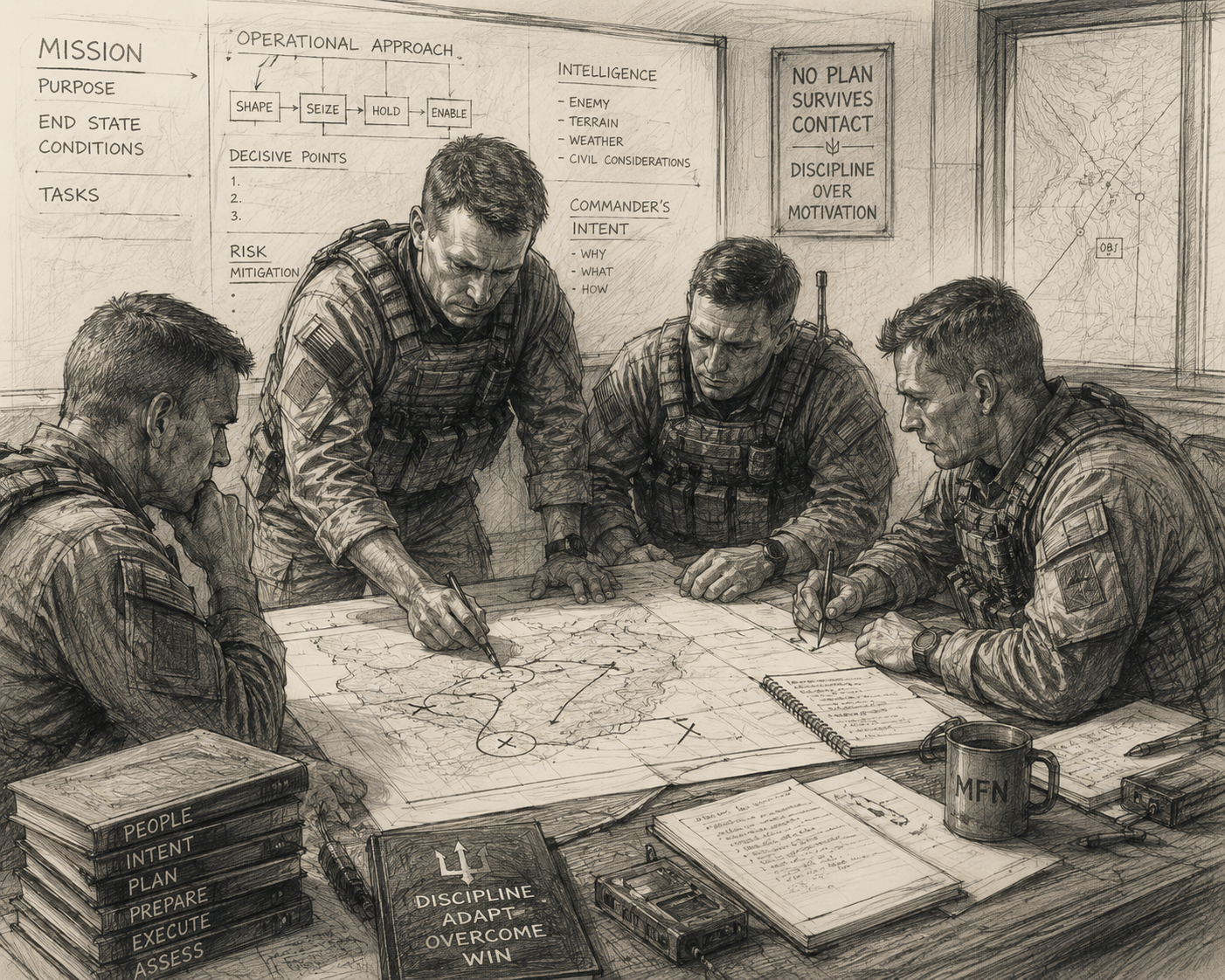
Ask most people to picture a veteran wellness retreat and they’ll describe something loose: a campfire, maybe a ropes course, a lot of goodwill and not much rigor. That picture misses what actually happens inside a Warriors’ Ascent cohort. Our program is not a bundle of activities that feel therapeutic. It is a manualized curriculum, built the same way I was trained to build professional military instruction, and it runs the same disciplined way every time a new cohort walks through the door.
That distinction, manualized versus improvised, is the difference between a program that can prove it works and one that just hopes it does.
A Curriculum Developer’s Eye on Healing
Before I became executive director of Warriors’ Ascent, I spent years as an instructor within the U.S. Army’s Command and General Staff College (CGSC), inside the School of Advanced Military Studies’ Advanced Military Studies Program (SAMS AMSP). SAMS trains the officers who plan and lead at the highest levels of military operations, and instructors there are required to complete the College’s Faculty Development Program (FDP) before we’re allowed near a seminar room.
FDP is not a weekend workshop. It trains instructors to design instruction against Bloom’s Taxonomy, the six-level framework (remember, understand, apply, analyze, evaluate, create), that governs how deeply a learner is expected to process material. Every block of instruction is built around terminal learning objectives, what a student must be able to do by the end, and enabling learning objectives, the specific, sequenced steps that get them there. The whole system is then stress-tested against CGSC’s Accountable Instructional System (AIS), a formal review cycle that uses after-action data to decide whether a curriculum earned its keep or needs to change.
That is the discipline I brought into building Warriors’ Ascent alongside Dr. Bruce Liese, clinical director at the University of Kansas’s Cofrin Logan Center for Addiction Research and Treatment and a professor at KU Medical Center with decades of published research in cognitive-behavioral therapy. Dr. Liese brought the clinical science. I brought the instructional design discipline to organize that science into something teachable, repeatable, and measurable. The result is a program manual, not a set of talking points a facilitator riffs on. Every cohort receives the same sequence of instruction, the same experiential activities, and facilitators who complete the same standardized training, because that is what “manualized” means: what worked for the veteran in an early cohort is exactly what a veteran in Cohort 76 receives today.
Outcomes, Not Vibes
Here is the discipline behind that word “manualized”: if you cannot state what a participant should be able to do differently by the end, you have no way to know whether you succeeded. Bloom’s Taxonomy exists because “they felt inspired” is not an outcome you can evaluate. “They can recognize a distorted thought in real time and choose a different response” is.
We hold Warriors’ Ascent to that same standard. In 2023, Dr. Liese and co-author Corey Monley published a peer-reviewed pilot study of our program in the Journal of Psychotherapy Integration, a formal outcomes evaluation of 50 veterans who completed the program and a posttreatment follow-up survey. The results were striking: statistically significant reductions in PTSD symptoms, depression, and high-risk drinking, alongside a program dropout rate of 2.9 percent, compared to an average dropout rate of roughly 36 percent across PTSD treatment generally.
Numbers like that do not happen by accident, and they do not happen through improvisation. They happen because every element of the program, the didactics, the sequencing, the experiential activities, was designed against a specific objective and then measured against it. That is the AIS mindset applied to healing: build it deliberately, measure it honestly, and improve it in small, evidence-based increments, cohort after cohort. Without an outcomes-based evaluation, you are not running a program. You are just shooting in the dark.
Three Modalities, Woven Into One System
Our curriculum integrates three evidence-based approaches to trauma, not as separate modules bolted together, but as a sequenced system, each one preparing participants for the next.
Cognitive-Behavioral Therapy (CBT) is the part most people have heard of. In plain terms, it teaches you that your thoughts, feelings, and actions are connected, and that a distorted thought, “I’m dangerous to the people I love,” “I should have died instead,” drives feelings and behaviors that keep you stuck. CBT gives participants tools to catch those thoughts and challenge them.
Mindfulness-Based Therapy (MBT) teaches something almost opposite: instead of arguing with a thought, you learn to notice it, and the emotion underneath it, without judgment and without needing to fix it immediately. For veterans who have spent years suppressing or numbing difficult emotions, this is often the hardest and most necessary skill, because you cannot use a CBT tool on a feeling you have not yet let yourself feel.
Emotion-Focused Therapy (EFT) picks up where mindfulness leaves off. It holds that underneath anger, the emotion most veterans present with, is almost always fear, grief, or shame that never got expressed. EFT creates guided, structured opportunities for participants to actually feel and express those buried emotions in front of people who understand, rather than avoid them for another year.
Sequenced this way, mindfulness builds the capacity to tolerate the very emotions that CBT and EFT ask participants to examine. It is not a menu people pick from. It is a curriculum.
The Group Is Part of the Treatment
None of this happens one-on-one. It happens in a small cohort, and that is deliberate. Decades of group therapy research identify specific therapeutic factors that occur only in a group setting, and four of them sit at the center of how Warriors’ Ascent is built.
Universality is the relief of discovering you are not the only one. A veteran who has spent years believing his rage or numbness makes him uniquely broken hears another veteran describe the identical experience, often within the first hours of the program.
Validation happens as participants tell their stories and are met not with judgment but with recognition, often for the first time outside their own head.
Installation of hope comes from watching someone further along, frequently a peer mentor who is a graduate of the program, function well. It is one thing to be told recovery is possible. It is another to sit across from someone who has already done it.
Modeling, what the published research calls imitative modeling, is what happens when a participant watches a peer lean into a hard exercise, express a buried emotion, or use a coping skill under pressure, and then discovers he can do the same.
These are not incidental byproducts of putting people in a room together. We design the schedule, the sequencing, and the pacing of activities specifically to produce them.
Mapping the Group Factors to the WA Objectives
Every one of those four group factors was chosen because it drives one of three categories of outcomes we design toward: behavioral, cognitive-affective, and interpersonal.
Universality and validation work primarily on the cognitive-affective objective, they change how a participant thinks and feels about his or her own experience, replacing shame and isolation with a different self-story.
Modeling and installation of hope drive the behavioral objective, participants leave able to point to a specific skill they watched someone else use and can now use themselves, whether that is a thought-challenging technique or a grounding practice under stress.
All four factors, especially the sustained proximity of a small cohort over five days, work on the interpersonal objective, participants relearn how to be around other people, tolerate vulnerability, and rebuild trust, skills many arrive without.
This is the part instructional design contributes that a purely clinical approach might not: we do not just hope these things happen. We build the schedule so they are close to guaranteed to happen, then we survey participants afterward to confirm they did.
What Comes Next: Operationalizing the System
Manualizing a curriculum is the first step. The next is turning it into something that functions like a true system: part diagnostic, capable of identifying where a specific participant is stuck, and part prescription, capable of directing that participant to the specific modality, group factor, or exercise that addresses it.
We have started calling this the Warrior Operating System. It is still early, but the idea is straightforward: if trauma disrupts a person across behavioral, cognitive-affective, and interpersonal domains in identifiable, recurring patterns, then healing should be systematized the same way, not a fixed script to be followed blindly, but a structured framework for assessing where someone is and what they need next.
More on that soon. For now, the point stands: what looks, from the outside, like a retreat is actually a curriculum, built the way rigorous instruction is always built, and that discipline is why it works the same way every time.
Sources
Liese, B. S., & Monley, C. M. (2023). Feasibility of multimodal group treatment for veterans with PTSD, depression, and high-risk drinking: A pilot study. Journal of Psychotherapy Integration. https://doi.org/10.1037/int0000309
University of Kansas Life Span Institute (2024). Pilot Study Demonstrates Potential for PTSD Treatment Program for Veterans, First Responders.
Yalom, I. D., & Leszcz, M. (2020). The Theory and Practice of Group Psychotherapy (6th ed.).