Uncategorized
Thinking About Thinking: The Science Behind Cognitive Mastery & Emotional Regulation
August 24, 2026
Category 1 of the Warrior Operating System | Warriors’ Ascent
In ten years of running cohorts for combat veterans and first responders, I’ve noticed something almost every one of them has in common walking in the door. They believe their reactions are simply who they are. Anger shows up out of nowhere. A conversation gets too close to something real and they shut down. They walk into a room full of people and feel certain everyone is watching them, judging them, waiting for them to fail.
They describe these reactions the way you’d describe weather, something that happens to them without warning and without cause. What we teach in the first module of Warriors’ Ascent is that these reactions aren’t weather at all. They’re a process, and every process can be understood, interrupted, and eventually rebuilt. That’s the premise underneath Category 1 of the Warrior Operating System, Cognitive Mastery and Emotional Regulation. Before we ask anyone to change their life, we teach them how their mind actually works.
Two Systems, One Brain
The foundation for this comes from Nobel laureate Daniel Kahneman’s landmark work, Thinking, Fast and Slow, which describes the mind as running on two distinct systems.
System 1 is fast, automatic, and effortless. It’s the system that identifies a threat before you’ve consciously registered it, reads a facial expression in a fraction of a second, and ducks before you’ve decided to duck. In combat, in a burning building, on a night patrol, System 1 kept you alive. It doesn’t ask permission. It fires first and explains itself later, if it explains itself at all.
System 2 is slower, deliberate, and effortful. It’s the system that weighs evidence, considers context, and can override System 1 when System 1 has misread the situation. System 2 is what allows you to recognize that the loud bang down the street was a car backfiring rather than incoming fire, and to act accordingly even while your body has already started reacting as though it were the latter.
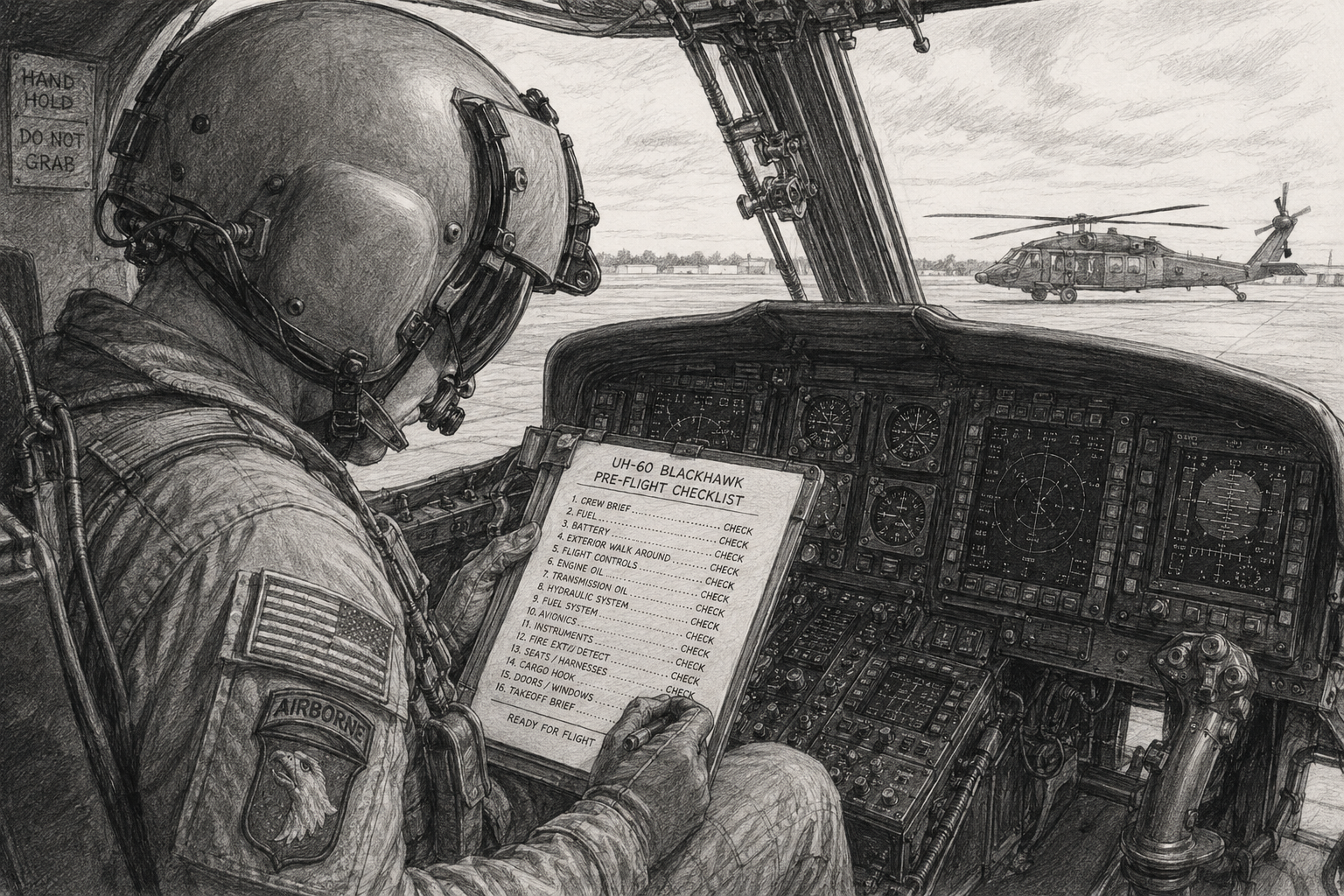
I think about an Army helicopter pilot I know who put this better than any textbook could. When he was learning to fly, every part of it ran through System 2. Scanning the instruments in a fixed sequence. Talking himself through each control input before he made it. Cross-checking altitude, airspeed, and attitude one at a time because his brain hadn’t yet built the pathways to do it any other way. That early training was slow and effortful on purpose, hundreds of hours of deliberate, conscious repetition until the aircraft stopped feeling foreign in his hands.
Years later, flying at night with an engine failure light illuminating the cockpit, there was no time left for that kind of processing. He didn’t run through a checklist step by step the way he had as a student. His hands were already on the controls, already flaring the aircraft and searching for a landing zone, before his conscious mind had finished registering what had gone wrong. That was System 1, and in that moment it saved his life and the lives of his crew. But System 1 only had the right response available to call on because System 2 had built it first, drilled it into the circuitry through years of deliberate practice until it no longer required deliberation at all.
That’s the relationship we’re really after in this category. System 2 is how you build the skill. System 1 is how you execute it under conditions where thinking would get you killed. The two aren’t in competition. One trains the other.
For many of the warriors we serve, years spent in environments where System 1 had to run the show, where hesitation could cost a life, rewired the brain to default to System 1 long after the mission ended. The deployment is over, the badge is turned in, but the nervous system never got word that the environment changed. That’s not a character flaw. That’s a system doing exactly what it was trained to do, in a context it was never built for.
The goal here isn’t to shut System 1 down. You’d be defenseless without it. The goal is to rebuild the connection to System 2, strong enough and fast enough to step in and evaluate the threat before System 1 has already run the show.
The Space Between What Happens and What You Do
There’s a concept we return to constantly throughout the program, and it’s simple enough to say in one sentence but takes most of us years to actually practice: between whatever happens to you and whatever you do about it, there is a space, and in that space lives your ability to choose your response instead of simply reacting.
This is the difference between reacting and responding. A reaction is automatic, immediate, and often driven entirely by System 1. A response is chosen. It still might involve anger, or fear, or the urge to walk away, but it’s filtered through a moment of awareness before it turns into action. Widening that space between stimulus and response is, in a very real sense, the entire goal of this category. Everything else we teach, from the cognitive triangle to the tools below, exists to make that gap a little bigger and a little easier to find under pressure.
The Triangle That Runs Your Life
The mechanism connecting System 1 reactivity to real world consequences is something we teach every warrior in the first week, the cognitive behavioral triangle. It’s simple enough to sketch on a napkin, and it explains far more of daily life than most people give it credit for.
Your thoughts drive your emotions. Your emotions drive your actions.
A car backfires. The automatic thought is I’m under attack. That thought produces an emotion, terror or a surge of adrenaline. That emotion produces an action, dropping to the ground in a grocery store, snapping at a spouse, or walking out of a meeting without explanation.
Most people, veteran or not, spend their lives believing the arrows only run one direction, that something happens and you simply feel and react from there. What we teach is that the thought is the hinge point. Learn to catch that automatic thought and question it before it fully takes hold, and you change everything downstream from it. This isn’t positive thinking, and it isn’t a matter of telling yourself not to feel a certain way. It’s the discipline of examining the interpretation your mind generated in a fraction of a second and testing it against the evidence, the same way you would assess any other piece of intelligence before acting on it.
The Distortions Running in the Background
If the triangle explains the mechanism, cognitive distortions explain why the thoughts firing in that first position are so often wrong to begin with. A cognitive distortion is a habitual, inaccurate pattern of thinking, a shortcut the brain takes that feels true in the moment but doesn’t hold up against the facts. In our cohorts, a handful show up again and again:
- All-or-nothing thinking, where one setback in the day gets translated into total failure as a person.
- Catastrophizing, where letting the guard down for even a second seems to guarantee something terrible will happen.
- Mind reading, the assumption that everyone in the room already sees you as broken.
- Emotional reasoning, where feeling dangerous is treated as proof that you actually are.
Underneath these moment-to-moment distortions sit limiting beliefs, deeper and more permanent conclusions the mind has drawn about who you are. I’m not the kind of person who gets to be happy. I’m too damaged to be a good father. Nobody who really knew what I did could still respect me. These beliefs rarely arrive out of nowhere. They tend to grow out of real experiences, generalized far past what the evidence actually supports, and then reinforced every time a fresh automatic thought seems to confirm them.
This is the trap. The distortion produces the emotion, the emotion produces the action, and the action seems to prove the original belief was right all along. It’s a closed loop, and closed loops rarely break on their own.
Naming What You Feel
One of the fastest ways to interrupt that loop is also one of the simplest, and it comes down to how precisely you name what you’re feeling. There’s a meaningful difference between saying “I am angry” and saying “I am feeling angry.” The first fuses you with the emotion, as if anger has become your identity in that moment. The second treats the emotion as a passing state, something moving through you rather than something you’ve become. Research on affect labeling backs this up directly: simply naming an emotion accurately, rather than staying fused with it or trying to push it away, measurably reduces its intensity and activates the same prefrontal regions responsible for deliberate, System 2 thinking.
This is really a question of emotional intelligence, and it starts with vocabulary. Most people default to a handful of broad emotional categories, mad, sad, fine, when the actual experience is something more specific: frustrated, disappointed, on edge, ashamed. The more precisely a warrior can name what’s actually happening internally, the more workable that emotion becomes. Vague feelings are hard to regulate. Named, specific feelings are something you can actually do something about.
Planning the Response Before You Need It
Widening the gap between stimulus and response gets a lot easier when you’ve already decided, in advance, what you’re going to do when the pressure hits. This is a skill borrowed from dialectical behavior therapy called coping ahead, and it pairs naturally with a related tool from behavioral science known as implementation intentions, the simple practice of deciding “if this happens, then I will do that” before the moment ever arrives.
The logic here is straightforward. In the middle of a triggered state, System 2 is exactly the resource that’s hardest to access. Trying to think clearly and creatively about the best response while your nervous system is already flooded is, for most people, a losing proposition. But a plan made in advance, during a calm moment, doesn’t require creative thinking in the crisis itself. It only requires recognition and execution. If I feel my chest tighten in a crowded room, then I will step toward the nearest exit and put my hand flat against the wall until my breathing slows. That single sentence, rehearsed ahead of time, does more real work in the moment than any amount of willpower summoned after the fact.
This also connects to something we talk about openly with our cohorts, the reality of decision fatigue. The capacity to make good, deliberate, System 2 decisions is not unlimited. It draws down over the course of a day, the same way physical energy does, and by the time a warrior is exhausted, overstimulated, or several hours into a hard shift, that reserve is often running on empty. This is precisely why pre-commitment matters so much. A decision made once, ahead of time, while the tank is full, doesn’t need to be remade from scratch in a moment when there’s nothing left in reserve.
Metacognition, Thinking About Your Thinking
All of this sits under one umbrella, and it’s the real skill being built throughout Category 1, metacognition, the ability to step back and observe your own thinking rather than being fused with it. Most people never learn to separate themselves from their thoughts. A thought arrives, I’m going to lose control, and it gets treated as fact rather than as a mental event that can be examined and questioned. Metacognition is the practice of noticing instead: I am having the thought that I’m going to lose control. That small shift, from being the thought to observing the thought, is what opens the space for System 2 to step in before System 1 finishes running its program.
This is the exact skill we build with a tool handed to every warrior in the first week and used for the rest of the program, the Daily Thought Record. Situation. Automatic thought. Emotion and its intensity. Evidence for the thought. Evidence against it. A more accurate reappraisal. On paper it looks almost too simple to matter. In practice it functions as a rep, the same way a sprint or a rucksack march is a rep, and reps are what actually change the system over time.
Which Brings Us to Neuroplasticity
None of this works as a single insight or a good conversation. It works because of a principle that used to be considered impossible in neuroscience and is now firmly established, neuroplasticity, the brain’s capacity to physically reorganize itself, building new neural pathways and weakening old ones in response to repeated experience and deliberate practice.
For decades, the prevailing belief was that the adult brain was essentially fixed, that whatever wiring you carried into adulthood was the wiring you were stuck with. We now know that isn’t true. The brain remains capable of meaningful change across the entire lifespan. Every time a warrior catches an automatic thought, examines it, and chooses a more accurate response over the default reaction, that’s more than a better moment in isolation. It’s laying physical groundwork for that response to come more easily the next time. The pathways you use get stronger. The pathways you stop using get weaker. That’s true of the trauma responses built under extreme conditions, and it’s equally true of the new patterns being built now to replace them.
This is the piece that turns a set of psychological concepts into something closer to an actual training program. Hypervigilance, avoidance, the shutdown response, none of these are permanent features of a damaged brain. They’re well worn pathways, built through repetition under conditions of survival. And well worn pathways can be rerouted through the same mechanism that built them in the first place, repetition, only this time under conditions of safety and deliberate practice.
The Bottom Line
Strip away the terminology and Category 1 comes down to a fairly simple idea. Your thoughts are not facts. Your reactions are not your identity. And your brain is not a finished project. System 1 got you through things System 2 never could have managed alone. But System 2, built and strengthened deliberately, is how you build a life on the other side of that. The tools are learnable. The wiring is changeable. And the first step, before any of the rest of it, is simply learning to notice the thought and name the feeling instead of being run by either one.
That’s where every warrior who comes through Warriors’ Ascent starts. Not with a five day miracle. With a rep.
Mike Kenny, Executive Director, Warriors’ Ascent
#WarriorsAscent #CognitiveMastery #Neuroplasticity #Metacognition #VeteranMentalHealth