Blog Post
WOS 1.0 to WOS 2.0: Why You Can't Optimize What You Haven't Stabilized
October 9, 2026
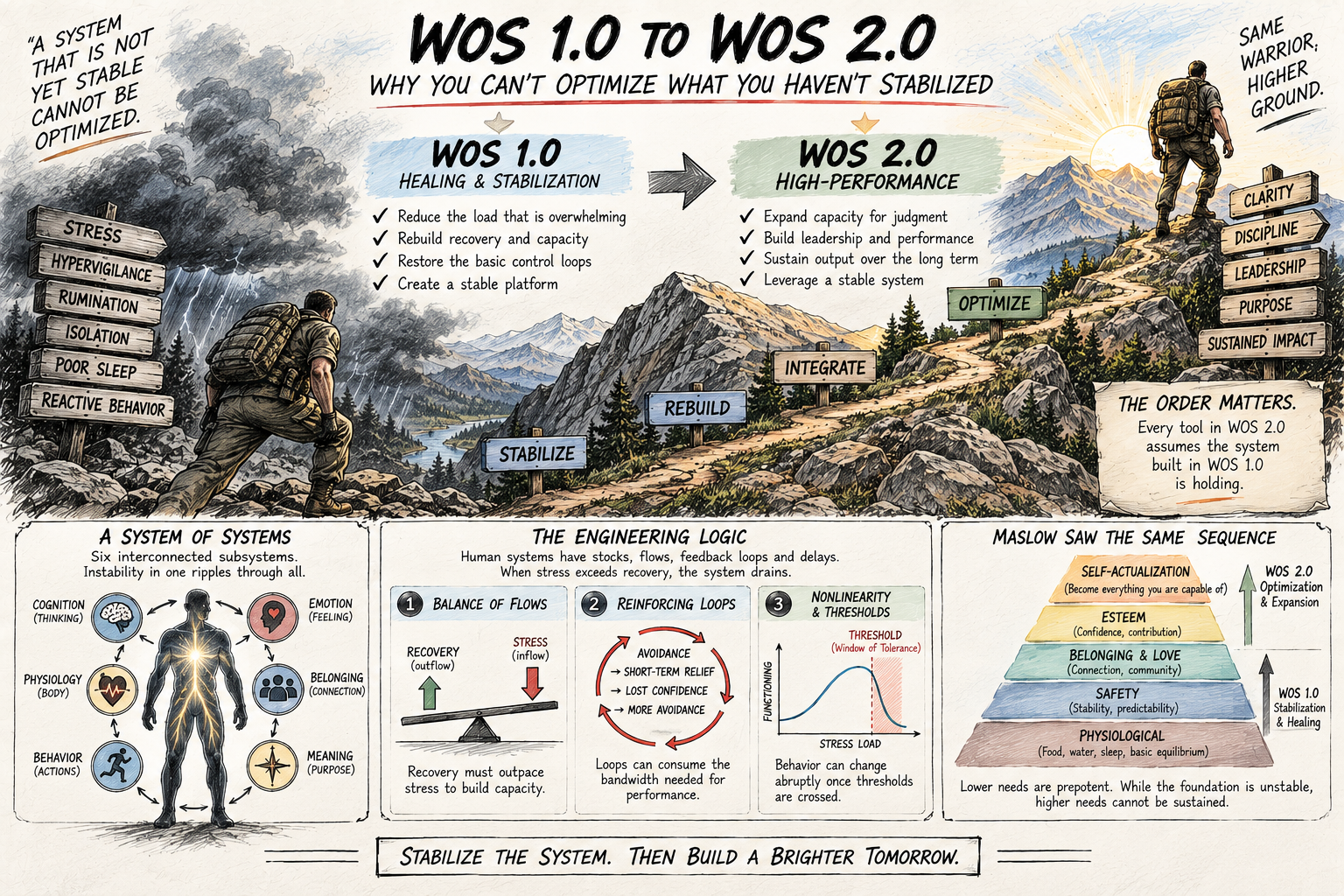
You cannot optimize a system that is not yet stable, and that principle governs how the Warrior Operating System is built. WOS 1.0 stabilizes the human system by reducing the load that is overwhelming it, rebuilding the recovery that replenishes it, and restoring the basic control loops a person needs to steer their own life. WOS 2.0, the high-performance layer of the framework, takes a stable system and expands its capacity for judgment, leadership, and sustained output. The order matters because every tool in the second layer assumes the first layer is holding. Warriors’ Ascent does the first job, and it does it on purpose.
Where This Comes From
A human being is a system of systems. Physiology, cognition, emotion, behavior, social belonging, and meaning each operate as a subsystem with its own capacity and its own feedback, and every one of them is coupled to the others. Poor sleep degrades attention and emotional control. Emotional volatility strains relationships, isolation erodes meaning, and a fractured sense of meaning makes it harder to sleep, stay disciplined, and decide well. Because the subsystems are coupled, instability in one propagates through the rest, and a gain in one can be erased by a breakdown in another. That is why optimizing a single subsystem rarely holds while the larger system is unstable. When the loops are already oscillating, pushing any one part harder amplifies the swings instead of improving the output. The whole system has to settle before any part of it can be tuned for performance.
My time in the US Army infantry and Special Forces taught me the same lesson. Every unit performs Preventive Maintenance Checks and Services (PMCS) on its weapons, vehicles, and equipment so that everything is fully mission capable (FMC) when the call comes. Nobody waits for a weapon to jam in a firefight to find out it was never cleaned. The human being is a weapons system too, and the same discipline applies. Sleep, recovery, emotional regulation, and connection are the maintenance checks, and neglecting them rarely shows up as a problem until the moment the system is needed most.
The Army also builds readiness in a fixed order. Individual training comes first, because a team cannot execute a battle drill if its members cannot yet shoot, move, and communicate on their own. Collective training builds on that foundation, and only after both does a Special Forces Operational Detachment Alpha (ODA) conduct a full mission profile (FMP), a culmination exercise (CULEX) that validates its readiness to execute the mission outlined in its mission letter. No commander skips straight to the FMP. Every prerequisite has to be met before a unit is certified ready, and high performance is earned the same way. We understand that intuitively when we talk about equipment and units. We are much worse at applying it to individuals, and worst of all at applying it to ourselves.
Over the past decade at Warriors’ Ascent, I’ve watched what happens when that sequence gets reversed. Veterans and first responders arrive having been told, sometimes for years, to push harder, set bigger goals, or simply get back out there. Most of them are already exceptional at pushing. What they are missing is a stable platform to push from, and every new demand placed on an unstable system makes it a little less stable than it was before.
The Engineering Logic
WOS models that system of systems as six coupled subsystems. Each one has stocks, meaning accumulated capacity such as energy, cognitive bandwidth, emotional buffer, social connection, and a coherent sense of meaning. Each has flows that drain or replenish those stocks, feedback loops that either spiral or regulate, and delays that hide damage until it surfaces all at once (Sterman, 2000). Three features of that model explain why stabilization has to come first.
The first is the balance of flows. Healing and performance both depend on recovery outpacing stress over time. When stress inflow exceeds recovery outflow week after week, the stocks drain, and adding performance demands only increases the inflow. A system running a deficit cannot be trained into surplus by asking more of it.
The second is reinforcing loops. Hypervigilance, rumination, avoidance, anger, sleep debt, and isolation each feed themselves. Avoidance brings short-term relief, the relief quietly erodes confidence, and the lost confidence makes the next round of avoidance more likely. While loops like these are running, they consume the very bandwidth any performance tool would need. Teaching advanced decision-making to someone caught in a rumination loop mostly gives them one more thing to ruminate about.
The third is nonlinearity. Human systems have thresholds, the edges of what Daniel Siegel called the window of tolerance (Siegel, 1999), and behavior changes abruptly once those edges are crossed. A person can look fine on average while their day-to-day state swings widely underneath, and that volatility is often the earliest warning of an approaching collapse. Delays compound the problem, because sleep debt, accumulated stress, and unprocessed grief can build for months before anything visible breaks. That is why so many people seem fine right up until they aren’t.
Taken together, these give us a practical way to judge when a system is stable enough to build on. We look at three things: level, or how well the person is functioning; trajectory, or whether that functioning is holding and improving rather than sliding; and stability, or how much it swings from one day to the next. Someone who scores well on all three has surplus capacity to invest. Someone with a decent average and wide swings is still in stabilization territory, however capable they look on a good day. That is the threshold between WOS 1.0 and WOS 2.0, and in our model it is something you can measure rather than guess at.
Maslow Saw the Same Sequence
Abraham Maslow described this ordering in human motivation more than eighty years ago. His hierarchy places physiological needs at the base: food, water, sleep, and the body’s basic equilibrium. Safety needs come next, meaning security, stability, predictability, and freedom from fear. Above those sit belonging and love, then esteem, and at the top self-actualization, which Maslow described as the desire to become everything one is capable of becoming (Maslow, 1943). His central claim was that the lower needs are prepotent. While a lower need goes unmet, it dominates attention and behavior, and the higher needs barely register as motivators. Only as the foundation is relatively satisfied do belonging, esteem, and self-actualization begin to pull a person forward. Maslow was clear that this is a matter of degree rather than a checklist, but the direction of the dependency runs one way.
Many of the veterans and first responders who come to us arrive with the bottom two tiers compromised, even when their lives look stable from the outside. Sleep is broken, the body is carrying a chronic stress load, and the nervous system still reads ordinary places and people as threats. In Maslow’s terms that is a physiological and safety deficit, and it pulls attention downward all day long. Asking that person to find a new calling, build a reputation in a second career, or set ambitious goals is asking them to work on the upper floors of a building whose foundation is still cracked.
The WOS architecture follows the same layering, and I arrived at it from systems engineering rather than psychology. Energy and biology form the base, emotional regulation sits above it and supplies the felt sense of safety, belonging, discipline, and decision-making occupy the middle, and meaning and identity sit at the apex. WOS 1.0 rebuilds that structure from the ground up, starting with sleep, physiology, and regulation, and then repairing belonging and identity on that footing. WOS 2.0 works at the top of the structure and assumes the base is already holding. The systems engineer and the psychologist land in the same place: the foundation determines what can be built on top of it.
One Category, Two Modes
The clearest way to see how the two layers relate is to follow a single category through both of them. Purpose and identity, Category 6 in this series, works well for that because it sits at the top of the WOS architecture, the same position self-actualization holds in Maslow’s hierarchy, and shapes everything beneath it.
In WOS 1.0, identity is something to repair. When a veteran takes off the uniform or a first responder turns in the badge, they lose a role, a tribe, a mission, and a daily set of standards all at once. Add trauma or moral injury, and the story they have been living inside can break entirely. The work at Warriors’ Ascent is narrative repair, helping participants rebuild a self-story that includes what happened to them without being defined by it. Dan McAdams’ research shows why that matters: people whose life stories carry redemption sequences report greater well-being than people whose stories bend toward contamination and loss (McAdams, Reynolds, Lewis, Patten, & Bowman, 2001). The Ceremony for the Dead gives grief and guilt a place to be named and honored, and the personal coat of arms gives each participant a visible record of what they still are: the service they gave, the people they love, and the virtues they never actually lost.
In WOS 2.0, the same category does a different job. Once a coherent identity is back in place, it can function as an engine instead of a wound. Daphna Oyserman’s research on identity-based motivation shows that people start more readily and persist longer when a behavior feels congruent with who they are, and that identity shapes whether difficulty reads as a reason to keep going or a reason to quit (Oyserman, 2009). For a leader operating under sustained pressure, a clear identity becomes the governor on discipline and judgment, settling many of the hardest decisions long before the moment arrives.
The dependency between the two is the whole point. Someone who does not yet know who they are without the uniform cannot use identity as a leadership engine, because the engine hasn’t been rebuilt. Asking that person to define a leadership philosophy or optimize a personal mission statement while their story is still broken places a performance demand on an unstable system. The 2.0 work is real and valuable, and it only works on top of what 1.0 restores.
The Pattern Holds Across All Six
The same dependency shows up in every category of the framework. Each one has a stabilization objective and a performance objective, and the second always assumes the first is in place.
| Category | WOS 1.0: Stabilize and Restore | WOS 2.0: Optimize and Lead |
|---|---|---|
| Cognitive Mastery & Emotional Regulation | Interrupt trauma-driven threat loops and restore access to executive control after dysregulation | Sharpen judgment quality, emotional containment, and command presence under pressure |
| Energy, Recovery & Physiological Readiness | Reduce allostatic overload and restore sleep and autonomic balance | Optimize energy efficiency and recovery discipline for sustained high output |
| Motivation & Discipline | Restore agency and self-efficacy after shame or helplessness | Build durable intrinsic motivation and long-horizon discipline systems |
| Planning & Decision-Making Under Pressure | Restore basic self-leadership and reliable follow-through | Develop strategic judgment and execution cadence in complex, high-risk environments |
| Belonging, Tribe & Interpersonal Dynamics | Repair attachment injury and restore trust and healthy boundaries | Build high-trust teams where cohesion and influence become performance assets |
| Purpose, Identity & Self-Actualization | Repair moral injury and restore a coherent self-story | Turn identity and values into the governor of leadership and ethical clarity |
Reading down the left column gives a fair description of what happens during five days at Warriors’ Ascent. Reading down the right column describes a different kind of work, suited to a different moment in a person’s life.
Where Warriors’ Ascent Fits
Warriors’ Ascent is a WOS 1.0 program, and I want to be precise about that, because precision is part of what makes the program credible. Our mission is stabilization and restoration for veterans and first responders carrying PTSD, depression, moral injury, and the loss of a role that defined them. That is the work our curriculum was built for, the work our facilitators and mentors are trained to deliver, and the work the peer-reviewed evidence describes. The pilot study published in the Journal of Psychotherapy Integration found statistically significant reductions in PTSD symptoms, depression, and high-risk drinking, with a dropout rate of 2.9% (Liese & Monley, 2023). Those are stabilization outcomes, and they are the right outcomes for the people we serve.
WOS 2.0 is the next level of the framework, the high-performance layer that builds on a stable foundation, and it sits outside what Warriors’ Ascent delivers. My own work on it has happened separately, in theory and in practical application with special operations professionals and leaders through the Special Operations Experience. If anything, that work has strengthened the sequencing argument. Even among people selected and trained for extreme performance, the ones who get the most out of performance work are the ones whose foundation is already holding.
What our graduates choose to do with their stability belongs to them. This September, Team Warriors’ Ascent ran the Pikes Peak Ascent to the 14,115-foot summit, and three of the runners had come through our program: Tim, a US Army engineer and firefighter; Brad, a US Marshal; and Dave, a US Navy veteran and ultramarathoner who now coaches the team. None of them came to us to train for a mountain. They came to get their lives back, went home, and rebuilt them over time, and the mountain came afterward. That order is the argument of this entire article, made visible on a summit in Colorado.
What This Means for Leaders and Organizations
This sequencing matters well beyond veterans and first responders. Organizations invest heavily in leadership development, performance coaching, and resilience training, often for people who are quietly operating in 1.0 territory: sleeping five hours a night, carrying unprocessed loss, isolated inside a demanding role, and running on reserves that have been draining for years. Performance tools handed to those people tend to produce a short burst followed by relapse, and the organization concludes the training didn’t work. The training may have been perfectly sound. It was delivered to a system that wasn’t stable enough to use it.
The practical question for any leader is which mode their people are actually in, and the honest answer is usually mixed. Some are ready to build. Others need their load reduced and their recovery restored first, and pushing them harder will cost more than it returns. For companies that employ or support veterans and first responders, sponsoring stabilization is one of the highest-leverage investments available, because everything the organization might later want from those people depends on it.
Stability Has to Hold
One more systems principle completes the argument. Stabilization doesn’t end on the last day of a program. Systems resist change, and old loops tend to reassert themselves under stress weeks or months later. Durable stability requires the new control loops to keep running after the cohort goes home, including the breathing practice, the protected sleep, the if/then plans, and the daily connection with people who understand. The weeks after the five days matter as much as the five days themselves, and in November I’ll write about what we’ve built to support graduates through that stretch.
Next week: The Six Loops That Run You (Until You Learn to Run Them), a field guide to the reinforcing loops WOS 1.0 is built to interrupt.
References
Liese, B. S., & Monley, C. M. (2023). Feasibility of multimodal group treatment for veterans with PTSD, depression, and high-risk drinking: A pilot study. Journal of Psychotherapy Integration. Advance online publication. https://doi.org/10.1037/int0000309
Maslow, A. H. (1943). A theory of human motivation. Psychological Review, 50(4), 370-396.
McAdams, D. P., Reynolds, J., Lewis, M., Patten, A. H., & Bowman, P. J. (2001). When bad things turn good and good things turn bad: Sequences of redemption and contamination in life narrative and their relation to psychosocial adaptation in midlife adults and in students. Personality and Social Psychology Bulletin, 27(4), 474-485.
Oyserman, D. (2009). Identity-based motivation: Implications for action-readiness, procedural-readiness, and consumer behavior. Journal of Consumer Psychology, 19(3), 250-260.
Siegel, D. J. (1999). The developing mind: Toward a neurobiology of interpersonal experience. Guilford Press.
Sterman, J. D. (2000). Business dynamics: Systems thinking and modeling for a complex world. Irwin/McGraw-Hill.